



Ever mixed up “I have gone” with “I went” and wondered why it mattered? Verb forms can confuse even the most confident speakers. This confusion often makes it difficult to write or speak naturally.
Here’s the good news: you don’t need to memorize dozens of grammar charts to get it right. Most verb patterns follow a few simple rules. These patterns appear frequently in everyday conversation and writing.
This guide will take you through present, past, and future verb forms in easy-to-understand language. You’ll learn how to choose the right structure for different situations. It’s useful whether you’re writing an email or talking to a colleague.
We’ll also cover the mistakes that often confuse learners. Each mistake has a simple fix you can use right away. There’s no complicated textbook language or confusing jargon here. Instead, you’ll get a friendly guide that builds your confidence step by step.
By the time you finish reading, everyday grammar choices should feel less intimidating.
Key Takeaways
- Understanding verb forms is about spotting patterns, not memorizing endless rules.
- Present, past, and future structures cover most everyday communication needs.
- Choosing the right form becomes easier once you know the core patterns.
- Common mistakes have simple, practical fixes you can start using today.
- Clear grammar builds confidence in both casual chats and professional writing.
- This guide skips complicated jargon in favor of straightforward explanations.
Why English Tenses Matter in Everyday Communication
Imagine texting your boss that you “finish” the report instead of “finished” it. That small change can make a big difference in what your boss understands about your work.
Knowing verb tenses in English helps you communicate clearly every day. Saying a meeting “happens,” “happened,” or “will happen” sends different messages to your team.
Good knowledge of English grammar tenses is important for more than casual conversation. A tense mistake in your resume, email, or report can make your message seem careless or unclear, even if your ideas are good.
Using the right tenses builds trust and makes your messages easy to follow.
English Tenses Explained: Present, Past, and Future at a Glance
English tenses describe three main time frames: present, past, and future. They are commonly taught through four forms: simple, continuous, perfect, and perfect continuous. However, the simple forms cover many everyday situations.
Understanding these three time frames helps you build accurate sentences. It also makes choosing the right tense in conversation or writing easier and less confusing.
Present Tense Forms and How to Use Them
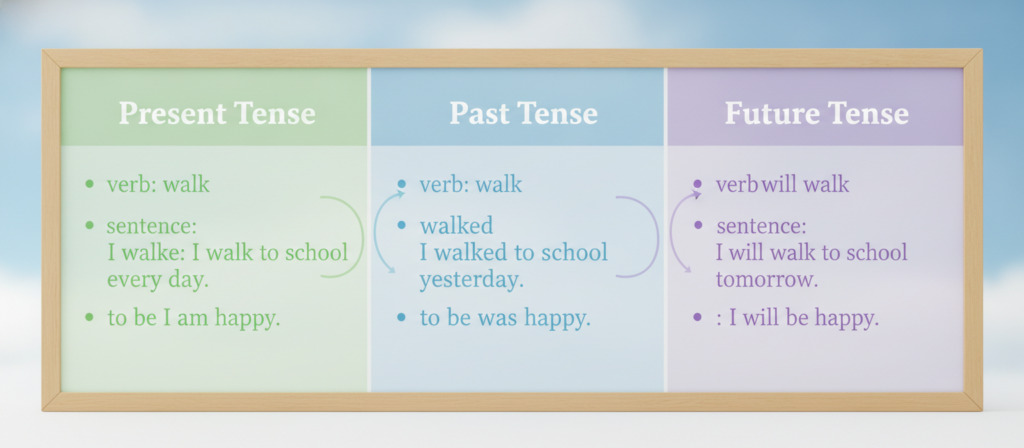
The present tense in English describes facts, routines, states, and actions connected to the present. The simple present tense uses the base form of the verb. For third-person singular subjects, add -s or -es, as in “She works from home.” With other subjects, use the base form, as in “They live in London.”
Use this form for stating facts, describing habits, or outlining schedules. For example, “Water boils at 100°C,” “I walk to work every morning,” or “The train leaves at 9 a.m.”
The present continuous, formed with am, is, or are plus an -ing verb, usually describes actions happening now, temporary situations, or changing circumstances. For example, “She is writing an email” or “More people are working from home this month.”
Past Tense Forms and How to Use Them
The past tense in English talks about actions, events, or states in the past. The simple past tense adds -ed to regular verbs, as in “walked” or “played.” However, many common verbs are irregular, such as “went,” “saw,” or “ate.”
Use this form for completed actions, particularly when there is a clear past-time reference. For example, “I visited Edinburgh last summer” or “She finished her report yesterday.”
The past continuous, formed with was or were plus an -ing verb, describes an action in progress at a specific past moment. For instance, “I was cooking dinner when the phone rang.” Understanding the simple past tense first can help you recognize how these forms work together.
Future Tense Forms and How to Use Them
The future tense in English talks about actions, plans, or predictions that haven’t happened yet. One common future structure pairs “will” with a base verb, as in “I will call you tomorrow” or “They will arrive on Friday.”
You can also express future plans with “going to,” especially for intentions that have already been decided. For example, “We are going to visit Scotland next month.” The present continuous can describe a future arrangement, as in “We are meeting the client at noon.” The simple present is often used for fixed schedules, as in “The meeting starts at noon.”
Use “will” for spontaneous decisions, promises, offers, or predictions. Use “going to” for prior intentions and predictions based on present evidence. These distinctions can help you sound more natural when talking about the future.
| Tense | Basic Structure | Example Sentence | Best Used For |
|---|---|---|---|
| Present | Subject + base verb (+s) | She teaches at a primary school. | Facts, habits, and routines |
| Past | Subject + verb-ed (or irregular form) | He passed his driving test last week. | Completed actions with a set time |
| Future | Subject + will + base verb | We will contact the client on Monday. | Decisions, promises, offers, and predictions |
How to Choose the Right Tense in Real-Life Situations
You may know the tense rules, but using them in real life can still be tricky. Conversations, emails, and reports don’t wait for grammar checks, so you need a quick way to pick the right tense without overthinking.
Use a simple decision framework. Ask yourself two questions before speaking or writing. Is the action happening now, did it already happen, or has it not happened yet? Is it a one-time event, an ongoing process, or something that repeats? Answering these questions will usually point you toward the correct tense.
Knowing how to use English tenses correctly changes how your message is received. A formal email about a delayed shipment needs different phrasing from a casual story about your weekend. The table below shows how tense choice shifts depending on the situation.
| Situation | Best Tense Choice | Example |
|---|---|---|
| Writing a formal business email | Present Perfect / Future with “will” | “We have reviewed your request and will respond by Friday.” |
| Recounting your weekend to a friend | Simple Past | “I visited my parents and cooked dinner on Saturday.” |
| Describing a future work arrangement | Present Continuous | “I’m meeting the client on Tuesday to finalize the contract.” |
Following clear English tense rules keeps your writing consistent, whether you’re drafting a report for your manager or texting a friend about your evening plans.
Common Tense Mistakes and How to Fix Them
Even confident English speakers make common tense mistakes without noticing. Spotting these patterns makes them easier to correct.
- Mixing past and present in one story: Saying “I go to the shop and bought milk” confuses your listener. Stick to one time frame: “I went to the shop and bought milk.”
- Using the simple present for a personal future arrangement: “I meet him tomorrow” sounds unnatural in most contexts. If the meeting is arranged, say “I’m meeting him tomorrow.” Depending on the meaning, “I will meet him tomorrow” may express a decision or promise.
- Forgetting the present perfect for a situation that continues: “I lived here for five years” refers to a finished period. If you still live there, say “I have lived here for five years.”
- Confusing simple past with present perfect: “I have seen him yesterday” combines the present perfect with a finished past-time marker. Say “I saw him yesterday” instead.
Reading your sentences aloud often reveals these errors faster than silent proofreading does.
Conclusion
Understanding English tenses is largely about time and the nature of an action. First, identify whether something happened in the past, is connected to the present, or will happen in the future. Then consider whether the action is finished, ongoing, repeated, or connected to another event.
Continuous forms help show actions in progress at a particular time. They can tell us that something is happening now, was happening at a past moment, or will be happening at a future moment. This adds a sense of ongoing activity rather than presenting the action as a single event.
Grammar rules become more natural with practice. Read English articles, write regularly, and speak as much as you can. Over time, you will recognize common patterns without needing to think about every rule.
Making mistakes is part of learning, so don’t let them hold you back. If a sentence seems confusing, refer to the explanations above. With regular practice, using the right tense will become easier and more automatic.
If you want personalized feedback on your speaking or writing, Your Native Teacher offers live online lessons with qualified teachers who can help you apply grammar to your own goals and real-life situations.