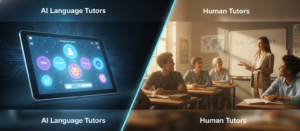




Can a smartphone app really teach you to speak French confidently? Many learners in the UK are asking whether artificial intelligence can replace a language tutor.
Some people enjoy the convenience of language-learning apps. Others find that nothing matches the personalised guidance of a real teacher.
Language-learning apps, pronunciation tools and AI chatbots have changed how we learn. They provide instant feedback, short practice activities and access from your phone at almost any time.
For learners, the decision is not simply a choice between convenience and quality. It is about understanding what each method can and cannot provide.
Every hour of study should move you closer to real conversations, not just more streaks or badges.
This article explores both sides of the debate. We will look at where AI is useful, where human expertise remains essential and how the two approaches can work together.
Key Takeaways
- Language-learning apps can make daily practice easier and more accessible.
- Convenience alone does not guarantee fluency or a deep understanding of culture.
- Human teachers can provide nuanced, personalised feedback that AI may miss.
- The right learning method depends on your goals, budget and available time.
- Combining teacher-led lessons with supplementary AI practice can support lasting progress.
1. The Rise of AI in Language Learning
You no longer need to be in a classroom every time you want to practise a new language. Artificial intelligence has made it possible to access fluent-sounding conversation practice from your phone. Thanks to language learning technology, apps can simulate many forms of human dialogue with increasingly natural responses.
These advances also power real-time feedback language learning tools. Pronunciation analysis, adaptive exercises and generative conversations are now widely accessible.
Language-learning apps and pronunciation tools can analyse aspects of your speech and adjust activities to your progress. They may respond in ways that feel conversational, making it easier to practise whenever you have a spare ten minutes, whether you are on a train or waiting in a queue.

An AI language learning conversation may begin with a structured scenario, such as booking a hotel room or asking for directions. Speech-recognition software can listen to your response, assess elements of your pronunciation and flag possible mistakes.
Generative models can then create more dynamic replies, allowing a session to move in different directions. Although this can make practice feel less like drilling flashcards, the quality and accuracy of the feedback can vary.
Why Instant Feedback and 24/7 Access Appeal to You
Real-time feedback language learning tools can identify some mistakes as you practise. Immediate correction may help you connect the feedback directly to the error. However, a qualified teacher can also provide instant correction during a live lesson while explaining why something is wrong and how to improve it.
Round-the-clock access is useful when your schedule is unpredictable. You can complete a short exercise before work or practise verb conjugations late at night without arranging a session. The table below compares this flexibility with live teacher-led lessons.
| Feature | AI Language Tools | Live Language Teacher |
|---|---|---|
| Availability | Usually available on demand | Available during scheduled sessions |
| Feedback speed | Instant automated feedback during practice | Immediate feedback and explanation during the lesson |
| Cost | May include free access or a subscription fee | Varies by teacher, format and lesson length |
| Personalisation | Algorithm-based and pattern-driven | Tailored to your goals, progress and communication needs |
2. AI vs Language Tutor: Where Human Expertise Wins
AI has made significant progress, but a human language tutor offers a different kind of support. A qualified teacher can combine linguistic knowledge, cultural context, teaching experience and empathy. These qualities are especially valuable when you need to use a language confidently in real situations.
Understanding Cultural Nuance and Context
Cultural nuance in language learning involves more than vocabulary. Idioms, humour, levels of formality and local slang can change according to the speaker, location and situation. A joke that works in Paris, for example, may be understood differently in Marseille.
AI can provide general explanations, but it may miss regional context or give an answer that sounds plausible without being appropriate. A knowledgeable teacher can explain when a phrase is natural, when a formal tone is expected and how meaning changes in different social settings.
Adapting to Your Individual Learning Style
Everyone approaches a new language differently. Some learners benefit from pictures and diagrams, while others need repeated speaking practice before new language becomes familiar. A good teacher notices these differences and adjusts the lesson accordingly.
Personalised language learning is more than following an automatically generated plan. It may involve changing the pace, selecting relevant topics or approaching a difficult concept in a new way. AI can adapt exercises based on performance data, but a teacher can also consider your goals, confidence and responses during the lesson.
The Power of Real-Time Correction and Motivation
Feedback from a human teacher does more than correct grammar. It can include a clear explanation, targeted practice and encouragement that helps you apply the correction in future conversations.
Language learning motivation often drops during difficult periods. A teacher can recognise a plateau, adjust the level of challenge and introduce relevant material to help you stay engaged. Automated reminders can support a routine, but they do not provide the same level of personal accountability.
Reading Body Language and Emotional Cues
Body language cues, tone of voice and hesitation can show a teacher that you are confused or uncomfortable. In a live video lesson, a teacher can notice these signals, check your understanding and adjust the explanation. AI systems may detect certain speech patterns, but they do not always interpret emotional or situational cues reliably.
| Aspect | AI Language Tools | Human Language Tutor |
|---|---|---|
| Cultural Nuance | Can explain common usage but may miss regional or situational context | Can discuss context, formality and natural usage in detail |
| Personalisation | Adapts activities using performance data and patterns | Adjusts lessons according to your goals, responses and progress |
| Motivation Support | Offers reminders, progress tracking and automated praise | Provides personal encouragement, accountability and targeted support |
| Emotional Awareness | May not reliably interpret hesitation, frustration or confusion | Can respond to verbal and visual cues during a live lesson |
| Real-World Fluency | Useful for repeatable simulations and low-pressure practice | Prepares you for spontaneous and goal-specific conversations |
Limitations of AI in Complex, Real-World Conversations
The limitations of AI language learning become clearer when conversations are sensitive, unpredictable or professionally important. Negotiating a contract, responding to humour or comforting a friend in another language requires more than producing grammatically correct sentences. It also involves judgement, tone and awareness of the relationship between the speakers.
AI can help you rehearse these situations, but its responses may be inaccurate or inappropriate. A qualified teacher can evaluate not only what you say but also how naturally and effectively you communicate.
3. Conclusion
The debate between AI and language tutors is not simply about choosing a winner. It is about understanding what each option provides and using it for the right purpose.
AI tools can be useful for quick drills, vocabulary review and additional conversation practice. They fit around a busy schedule and can help you maintain a regular learning habit.
A human language tutor, however, provides personalised explanations, meaningful interaction and feedback based on your specific goals. This is particularly important when you need to improve speaking confidence, understand cultural context or prepare for real-world communication.
For most learners, the strongest approach is to use AI as a supplementary practice tool rather than a replacement for teacher-led learning. Use online tools for daily review and live lessons for deeper learning, correction and genuine conversation.
At Your Native Teacher, learners can work online with qualified teachers and receive personalised guidance based on their level, goals and learning needs. AI tools can then support that structured learning between lessons.