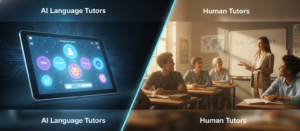




Have you ever used a translation app and wondered whether it could replace a real teacher? Across the UK, many learners now use AI language learning apps as part of their studies. They may swap textbooks for smartphones and receive instant feedback outside the traditional classroom.
This trend raises questions about the role of human teachers in language learning. You might wonder whether working through flashcards or chatting with an AI tool can be as effective as speaking to someone who understands your goals and challenges.
This article looks at both sides of the debate. It highlights the genuine strengths of smart learning platforms and the value of a skilled teacher. The most effective approach often lies somewhere in between. Understanding what modern tools can and cannot do will help you make better decisions about how to learn.
Key Takeaways
- Smart apps can make daily practice more convenient and accessible.
- Human educators provide cultural insight, empathy and personalised support that AI cannot fully replicate.
- Combining digital tools with guidance from a qualified teacher can support steady progress towards fluency.
- Understanding the strengths and limitations of each option helps you build a more effective study plan.
- The future of language learning is likely to combine technology with human connection rather than replace one with the other.
- Learners can pair apps with live instruction to create a balanced learning experience.
1. The Growing Role of AI in Language Education
Language education in the UK has changed significantly over the past decade. Technology now plays an important role in practising grammar, vocabulary, listening and pronunciation. Understanding this shift can help you decide how AI fits into your own learning plan.
1.1 How AI Tools Are Reshaping the Way You Learn a New Language
AI language learning apps have changed how many people study each day. Speech-recognition software can assess aspects of pronunciation and provide immediate feedback. This gives you an opportunity to notice and practise certain mistakes between live lessons.
Chatbots let you practise written or spoken exchanges without booking a time slot. Adaptive apps can also adjust exercises according to your answers and use game-like features to encourage regular study.
These tools have expanded the role of AI in language education. They provide convenient opportunities for independent practice, although their feedback is not always as accurate, nuanced or personalised as feedback from a qualified teacher.
1.2 Why This Question Is on Everyone’s Mind Right Now
The debate about AI replacing language teachers has intensified as generative AI has become widely accessible. This has made basic AI language tutors available for free or through relatively inexpensive subscriptions.
App subscriptions often cost less than regular private lessons, while social media and education headlines continue to draw attention to the issue.
Some people argue that AI will make teachers unnecessary, while others see it mainly as another learning tool. In practice, each option serves a different purpose. Understanding those differences can help you make better choices for your learning.
2. Will AI Replace Language Teachers? What the Technology Can and Can’t Do
Before deciding whether an app can replace a teacher, it helps to understand what each option offers. AI can be a valuable part of a study routine. It performs well in several areas, but it also has important limitations.
2.1 The Real Strengths of AI Language Apps
AI is particularly useful for repetition. It can present the same type of exercise as often as needed without becoming impatient.
Spaced-repetition algorithms can help you review vocabulary at useful intervals. Pronunciation tools may also identify certain differences between your speech and a reference recording, although their scores should not be treated as definitive.
AI chatbots for language learning provide a low-pressure environment for practice. You can use them at almost any time, and many tools are less expensive than private instruction. However, affordability and convenience do not necessarily make them a complete substitute for expert guidance.
- Consistency: Exercises can follow a predictable structure each day.
- Availability: You can practise whenever it suits your schedule.
- Instant feedback: Automated corrections are usually delivered quickly.
- Affordability: Many apps provide inexpensive options for additional daily practice.

| AI Strength | What It Does | Why It Matters |
|---|---|---|
| Spaced repetition | Resurfaces vocabulary at planned intervals | Supports long-term retention |
| Pronunciation analysis | Compares elements of your speech with reference samples | Can highlight areas for further practice |
| On-demand chatbots | Simulates conversation at any time | Provides low-pressure practice |
| Low-cost access | Often uses a free or subscription-based model | Makes additional daily practice more affordable |
2.2 Where AI Still Falls Short
Despite its strengths, AI still has significant limitations. Two areas are particularly important in language education.
2.2.1 Limited Emotional Intelligence
An app may not recognise when you are frustrated, confused or losing confidence. Emotional intelligence in teaching involves noticing how a learner is responding and adapting the lesson accordingly. Although AI can react to text or voice inputs, it does not interpret emotion and nonverbal cues with the depth and reliability of an attentive teacher.
2.2.2 Difficulty With Cultural Nuance
Language involves more than words and grammar. Cultural nuance in language learning includes humour, idioms, tone, politeness and social expectations that vary across regions and situations.
An AI system may miss sarcasm or give an incomplete explanation of formal greetings in Mandarin, for example. As a result, a response can be grammatically correct but inappropriate for the social context.
3. Why Human Teachers Still Hold the Advantage
Despite rapid advances in technology, human language teachers continue to offer capabilities that AI cannot reliably reproduce. The debate about AI vs human teachers can overlook the unpredictable nature of real communication. This is where skilled teachers are especially valuable.
Fluency Built Through Real Conversation
You develop fluency by taking part in meaningful conversations, not simply by following a script. A human teacher can ask an unexpected question, recognise hesitation and change the level or direction of the conversation in response.
This flexibility reflects what happens in everyday communication. AI chatbots can generate varied responses, but they may misunderstand your intended meaning, overlook recurring problems or provide corrections that lack context.
Cultural Insight You Can’t Download
Language and culture are closely connected, and knowledgeable teachers can explain that relationship in context. A teacher with relevant linguistic and cultural experience can provide practical examples of how people communicate in different situations.
They can explain why a phrase may sound rude in one context but friendly in another. They can also help you understand how tone, relationships and local conventions influence meaning—areas in which automated explanations may be incomplete.
The Human Connection That Keeps You Motivated
Learning a language takes time, and motivation can fluctuate. A dedicated teacher can notice when you are struggling and adjust the lesson, pace or activities to help you move forward.
They can also recognise genuine progress and provide meaningful encouragement. This relationship creates accountability and gives you a clear reason to prepare for and attend your next lesson.
| Learning Aspect | AI Language Apps | Human Language Teachers |
|---|---|---|
| Conversational Fluency | Generated or structured practice that may lack full context | Spontaneous dialogue adapted to the learner |
| Cultural Context | Information based on training data and programmed sources | Contextual explanations informed by relevant knowledge and experience |
| Motivation and Accountability | Automated reminders, goals and streaks | Personal encouragement, feedback and rapport |
| Adaptability Mid-Conversation | Can adapt responses but may misunderstand intent or context | Real-time adjustment based on your needs and reactions |
4. Conclusion
Will AI replace language teachers? A complete replacement appears unlikely in the foreseeable future. AI tools can make practice more accessible and structured, offering frequent opportunities to review vocabulary, grammar and pronunciation. However, they cannot fully replace the judgement, empathy and guidance of a skilled teacher.
Language fluency develops through meaningful communication, regular practice and useful feedback. A teacher can understand your difficulties, recognise your progress and adapt instruction to your goals and learning pace.
AI is best treated as a supplementary practice tool rather than a complete teacher replacement. It can be useful for drills, vocabulary review and additional pronunciation practice. For personalised correction, nuanced conversation and a structured learning plan, working with a qualified teacher remains highly valuable.
At Your Native Teacher, learners can take live online lessons with qualified teachers and receive personalised guidance based on their goals. AI tools can then support that instruction by providing extra practice between lessons.
Technology will continue to improve, but language learning will remain closely connected to human communication. Choose tools that support your practice and teachers who can guide your wider progress.