


Ever wondered why some people make rapid progress in French while others study German for years? The honest answer is that language-learning timelines depend on both the language and the learner.
The Foreign Service Institute provides estimated training times for languages taught to English-speaking U.S. government personnel. These benchmarks come from decades of intensive language training, but they should be treated as guidelines rather than precise predictions for every learner.
This guide explains the FSI language categories, which group languages according to the training time typically required for English speakers to reach professional working proficiency. You’ll see why some languages generally take longer to learn than others.
Language family, previous study and regular practice all affect your timeline. This article walks you through each factor step by step so that you can build a personalised study plan for lasting progress.
You’ll also get a practical framework for setting realistic goals based on your target language, prior experience and weekly study commitment.
By the end, you’ll have a clearer idea of how long learning a language may take and how to make steady progress without relying on unrealistic promises.
Key Takeaways
- The FSI groups languages into four broad difficulty categories based on the intensive training typically required for English-speaking learners.
- Your personal timeline depends on the target language, your native language, your goals and your previous language-learning experience.
- Category I languages such as Spanish and French typically require about 600 to 750 class hours to reach professional working proficiency in the FSI setting.
- Consistent weekly practice is generally more effective than occasional, intensive study sessions.
- Setting a realistic timeframe can help you stay motivated and track meaningful progress.
- A tailored study plan built around your specific goals can make your learning more focused and efficient.
How Long Does It Take to Learn a Language According to the FSI?
The U.S. Foreign Service Institute has developed language-difficulty groupings based on its experience training English-speaking government personnel. Its estimates indicate how long learners with suitable aptitude may need to reach professional working proficiency through intensive, structured instruction.
These estimates are useful reference points, but they do not predict exactly how long an independent or part-time learner will need. FSI students follow demanding training schedules and typically complete additional study outside class.
What the FSI Rankings Mean for Your Learning Timeline
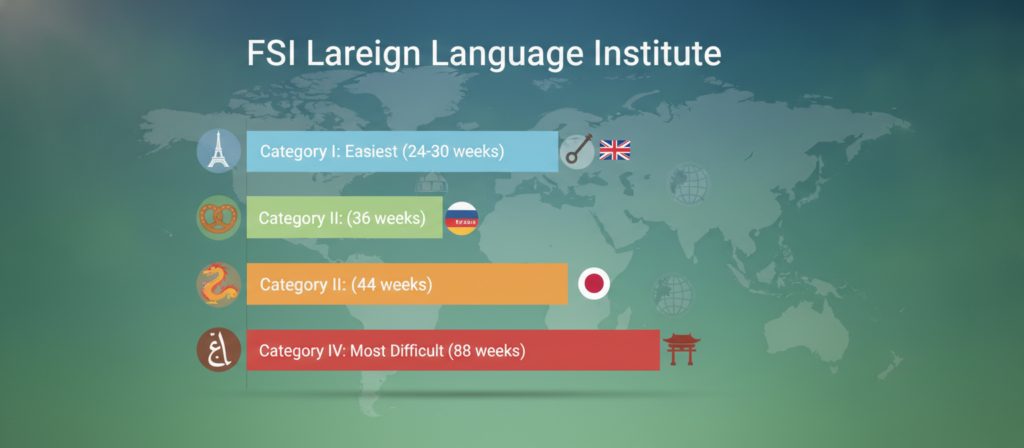
The current FSI framework commonly groups languages into four categories. Category I languages generally require the least training time for English speakers, while Category IV languages require the most.
The differences reflect factors such as linguistic distance from English, grammar, vocabulary, pronunciation and writing systems. Languages with familiar vocabulary or sentence patterns may be quicker for English speakers to learn, while unfamiliar scripts, tonal systems or substantially different grammar can add to the challenge.
Each category has an estimated number of class hours needed to reach professional working proficiency. These FSI hours by language provide a useful benchmark, although your own timeline will also depend on your goals, learning environment and opportunities to use the language.
| Category | Estimated Class Hours | Example Languages | Relative Difficulty |
|---|---|---|---|
| Category I | 600–750 | Spanish, French, Italian, Dutch | Generally the quickest for English speakers |
| Category II | 900 | German, Indonesian, Swahili | Moderate |
| Category III | 1,100 | Russian, Hindi, Vietnamese, Thai | Hard |
| Category IV | 2,200 | Arabic, Mandarin Chinese, Japanese, Korean | Exceptionally time-intensive |
Category I Languages: Generally the Fastest to Learn
Category I includes several of the languages that native English speakers can generally learn most quickly. Spanish, French, Italian, Portuguese and Dutch are in this group.
These languages use the Latin alphabet and share some vocabulary or linguistic features with English. In the FSI’s intensive training environment, learners typically need about 600 to 750 class hours to reach professional working proficiency.
This corresponds to roughly 24 to 30 weeks of full-time FSI training. A part-time learner may need considerably longer, especially when independent study, practice and breaks between sessions are taken into account.
Category II and III Languages: Moderate to High Difficulty
Category II and III languages generally require more training than Category I languages. German and Indonesian are commonly placed in Category II, while Russian is in Category III.
German has grammatical features and word-formation patterns that can challenge English speakers. Russian uses the Cyrillic alphabet and has a case system. Indonesian uses the Latin alphabet but differs from English in its grammar, vocabulary and usage.
FSI benchmarks suggest about 900 class hours for Category II languages and about 1,100 for Category III languages. These figures refer to professional working proficiency in an intensive training setting, not guaranteed fluency for every learner.
Category IV Languages: The Most Time-Intensive
Category IV languages require the most training in the FSI framework. Arabic, Mandarin Chinese, Japanese and Korean are in this group.
Depending on the language, learners may encounter unfamiliar writing systems, tonal distinctions, significant dialect variation or grammar structures that differ substantially from English.
The FSI benchmark is approximately 2,200 class hours, usually delivered over about 88 weeks of intensive training. Part-time learners may need several years, and the actual timeline will depend on their goals, consistency and access to meaningful practice.
How to Set a Realistic Timeline for Your Language Goals
To turn FSI benchmarks into a practical plan, follow four steps. Instead of choosing an arbitrary deadline, create a language study plan informed by the benchmark and your circumstances. These steps will help you set realistic language goals that fit your life.
Identify Your Target Language’s FSI Category
First, find out where your target language falls within the FSI framework. Spanish, French and Dutch are in Category I. Mandarin, Arabic and Japanese are in Category IV. Knowing the category gives you a useful starting point.
Once you have confirmed the category, you will have a baseline range of class hours. Remember that this is an estimate for a specific intensive training context rather than a universal requirement.
Estimate Your Required Study Time
With your category identified, use its estimated hours as a planning reference. Category I languages generally require 600 to 750 FSI class hours, while Category IV languages have a benchmark of approximately 2,200 class hours.
Think of this number as a guide, not a promise. The FSI benchmarks assume intensive, structured instruction for selected learners, and FSI students may also study outside class. Your actual time will vary according to your starting point, objectives, learning methods and consistency.
The table below provides a simple mathematical conversion of the benchmark hours into weeks. It does not mean that a few weekly hours of casual study are directly equivalent to the FSI’s intensive programme, and you may also need independent review and real-world practice.
| FSI Category | Benchmark Class Hours | 5 Hrs/Week | 10 Hrs/Week | 20 Hrs/Week |
|---|---|---|---|---|
| Category I | 600–750 | 120–150 weeks | 60–75 weeks | 30–38 weeks |
| Category II | 900 | 180 weeks | 90 weeks | 45 weeks |
| Category III | 1,100 | 220 weeks | 110 weeks | 55 weeks |
| Category IV | 2,200 | 440 weeks | 220 weeks | 110 weeks |
Assess Your Personal Learning Factors
Knowing the benchmark hours is not enough. Several personal factors can change your timeline, including your starting level, previous experience, learning goals and the amount of time you can commit each week.
Previous Language-Learning Experience
Knowing a related language can make some aspects of a new language easier. For example, a Spanish speaker learning Italian may recognise vocabulary and grammatical patterns. Previous experience can also help you understand how to organise your study, although it does not remove the need for sustained practice.
Weekly Time Commitment Available
Your weekly study commitment is crucial. Studying five hours a week will usually produce a longer overall timeline than studying twenty hours a week. However, the quality and regularity of those hours also matter. Be honest about your schedule so that your plan remains sustainable.

Build a Study Plan Around FSI Benchmarks
Now put the information together. Divide the benchmark hours by your realistic weekly study time to produce a rough timeframe, but allow additional time for revision, conversation practice and interruptions.
Break your timeline into monthly goals and weekly tasks. You might set separate targets for vocabulary, listening, speaking, reading and writing. Review your plan every few months and adjust it according to your progress.
Structured lessons and personalised feedback can also help you identify weaknesses that are difficult to notice on your own. At Your Native Teacher, learners can work online with qualified teachers and receive guidance based on their current level and goals.
Conclusion
The FSI framework is a useful guide for estimating how demanding a language may be for an English-speaking learner. It can help you set expectations, but it should not be treated as a countdown to guaranteed fluency.
How quickly you learn depends on your weekly study time, chosen resources, previous experience, lesson quality and opportunities for meaningful communication. Two people learning the same language can progress at different speeds, and that is perfectly normal.
Use the FSI framework as a starting point rather than a strict rulebook. Adjust your plan based on your progress, priorities and the skills you actually need.
Choose your target language, identify its benchmark and schedule manageable study sessions. With consistent practice, useful feedback and realistic goals, you can continue moving towards practical proficiency.