


Ever wondered how your language skills compare to a global standard? This is important if you’re applying to a UK university, getting ready for IELTS, or looking for a job abroad. You need a clear way to measure your skills.
Maybe you’re just tracking your own progress as a self-directed learner. Either way, understanding this scale helps you set real, achievable goals.
The Common European Framework of Reference is key here. It’s an internationally recognized system with a six-tier scale, from A1 to C2. This scale shows your growth from a complete beginner to a confident, fluent speaker.
Universities, employers, and exam boards in the UK use this framework. Knowing your tier tells you what skills you’ve mastered and what’s next.
This guide breaks down each tier in simple terms. You’ll leave with a solid understanding of English proficiency levels and a clear roadmap for your next step.
Key Takeaways
- The CEFR framework uses six tiers, A1 through C2, to measure language ability worldwide.
- UK universities, employers, and exam boards like IELTS and Cambridge rely on this scale.
- Each tier reflects specific skills in speaking, listening, reading, and writing.
- Knowing your current tier helps you set realistic, achievable learning goals.
- This guide offers a practical breakdown of what each level demands.
- Tracking your tier gives you a clear path toward your next milestone.
1. What Is the CEFR Framework and Why It Matters
The Council of Europe worked for nearly a decade to solve a big problem. They wanted to compare language skills across different countries and testing systems. This effort led to the Common European Framework of Reference for Languages, or CEFR framework, published in 2001.
This system created a shared language proficiency scale that everyone could understand. Before the CEFR, terms like “fluent” or “conversational” meant different things to different people.
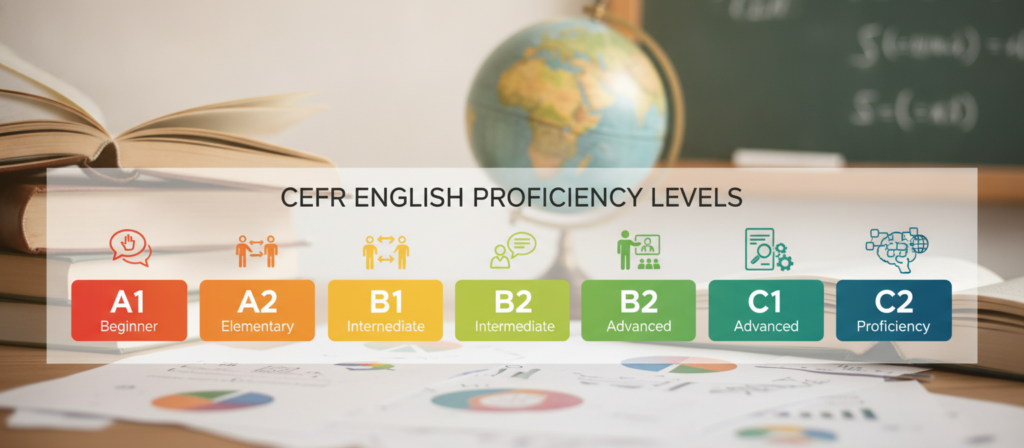
The CEFR framework fixed this problem by defining six levels: A1, A2, B1, B2, C1, and C2. Each level shows what you can do in four key skills:
- Listening: your ability to follow spoken language, from simple phrases to complex debates
- Speaking: your capacity to communicate ideas clearly, whether ordering coffee or presenting a business case
- Reading: your comprehension of written text, from basic signs to dense reports
- Writing: your skill in producing clear, well-structured messages for different purposes

In the UK, the CEFR framework is important beyond school. Major exam boards like IELTS, Cambridge English Qualifications, and Trinity College London use CEFR standards for scoring.
This means a B2 result on one test is the same as on another. You get a widely recognized measure of your English language levels. This is useful for visa applications, university admissions, and job applications.
UK Visas and Immigration often check for a specific CEFR level for certain visas. Universities set minimum CEFR levels, like B2 or C1, for international students. Employers also list required CEFR levels in job postings instead of vague terms like “strong English skills.”
The CEFR framework is not just for academics. It’s a tool that immigration officers, admissions staff, and hiring managers use daily. They use it to make fair judgments about your communication skills.
2. Understanding English CEFR Levels From A1 to C2
The CEFR scale breaks English ability into six checkpoints. Each one marks a clear jump in what you can say, write, and understand. Think of it as a staircase rather than a single test score. Every step builds on the skills you gained before, so knowing where you stand helps you plan exactly what to learn next.
Below, you’ll find a breakdown of each stage, from your very first words in English to the kind of fluency that matches a native speaker. Real examples from daily life in the UK—ordering coffee, chatting with a neighbor, or writing a work email—show what each level looks like in practice.
2.1 A1: Beginner Level Skills
At the A1 English level, you’re just starting out. You can understand and use simple, everyday phrases like greetings, numbers, and basic questions.
You can introduce yourself, say where you live, and ask someone their name. Ordering a sandwich at Greggs or filling out a basic form at a GP surgery falls within reach.
Conversations at this stage stay short and rely heavily on the other person speaking slowly and clearly. Grammar mistakes are common, but that’s expected and completely normal.
2.2 A2: Elementary Level Skills
The A2 English level opens up more everyday situations. You can talk about your family, your job, and your daily routine using simple, direct sentences.
Shopping trips become easier. You can ask for prices, compare items, and handle basic small talk with a shop assistant at Tesco or Sainsbury’s.
You’ll also manage short written messages, like a text to a friend or a simple email confirming plans. Past and future tenses start appearing, though sentence structure remains fairly basic.
2.3 B1: Intermediate Level Skills
Reaching the B1 English level means you can hold your own in most everyday situations. Travel becomes far less stressful, since you can ask for directions, book accommodation, and handle unexpected problems while abroad.
You’re able to express opinions on familiar topics and explain the reasons behind them. Describing past experiences, hopes, and future plans no longer feels like a struggle.
Many UK visa and citizenship applications set B1 as the minimum requirement, which makes this level a practical milestone for anyone settling in Britain long-term.
2.4 B2: Upper-Intermediate Level Skills
The B2 English level marks a real turning point. You can follow the main ideas in complex texts, including articles on technical subjects related to your field.
Spontaneous conversation with native speakers becomes realistic at this stage. You can join a workplace meeting, argue a point clearly, and adjust your tone depending on the audience.
Many UK university foundation courses and skilled job roles expect this level as a baseline. It signals that you can function professionally without constant translation support.
2.5 C1: Advanced Level Skills
At the C1 English level, language starts to feel flexible rather than fixed. You can express ideas fluently and spontaneously, without obviously searching for the right words.
Academic writing, detailed reports, and nuanced professional emails become manageable. You’ll also pick up on implied meaning, humor, and tone that a lower level might miss entirely.
This level often satisfies entry requirements for UK master’s programs and skilled worker visa applications, making it a strong benchmark for career growth.
2.6 C2: Mastery Level Skills
The C2 English level represents near-native mastery. You can understand virtually everything you hear or read, including fast native speech, dense academic texts, and literary work.
Precision becomes your strength here. You can summarize complex information from multiple sources, argue subtle points persuasively, and adapt your style for any audience or setting.
Few learners reach this stage, and honestly, few need to for everyday life or most careers. It’s the level expected of university lecturers, professional translators, and senior diplomats.
Here’s a quick CEFR level chart summarizing what each stage looks like in practice:
| CEFR Level | Common Name | Core Ability | Real-World UK Example |
|---|---|---|---|
| A1 | Beginner | Basic phrases and self-introduction | Ordering food at a café |
| A2 | Elementary | Simple conversations on familiar topics | Shopping at a supermarket |
| B1 | Intermediate | Handling travel and expressing opinions | Meeting UK visa requirements |
| B2 | Upper-Intermediate | Fluent, spontaneous professional discussion | Joining a workplace meeting |
| C1 | Advanced | Nuanced academic and professional writing | Studying for a UK master’s degree |
| C2 | Mastery | Near-native precision and subtlety | Lecturing at a UK university |
3. Conclusion
Knowing your CEFR level changes how you learn English. Each level, from A1 to C2, shows real skills for classrooms, workplaces, and daily talks in the UK.
The best way to find your level is through an official English level test. These tests check your reading, writing, listening, and speaking. If you’ve taken IELTS, you can use the IELTS CEFR equivalent chart to see your current level.
Knowing your English level helps set clear goals. Instead of vague goals, aim for specific levels like moving from B1 to B2. This focus saves time and makes studying more effective.
Improvement comes from steady effort, not quick fixes. Book a test, join a course, or practice daily with materials for your level. Every step you take moves you closer to your English goals.