


Ever paused, unsure which article to use before a German noun? It’s normal, especially for new learners. Three small words can seem surprisingly difficult to get right.
English speakers often find this challenging because modern English does not assign grammatical gender to most nouns. In German, every noun has a gender, which helps determine the article and related grammatical forms you need.
The German der, die, das system can confuse even confident learners. However, once you understand the main gender patterns, choosing the correct article becomes easier.
This guide explains what each article means and why the system is important. You’ll also learn practical memory tricks to help you remember noun genders and speak with more confidence.
By the end, you should find many everyday nouns much less confusing.
Key Takeaways
- Every German noun has one of three genders: masculine, feminine, or neuter.
- The correct form of an article depends on gender, case, and number.
- Gender often follows patterns based on word endings and noun categories.
- Memory tricks and color-coding can speed up recall.
- Consistent practice with complete phrases and sentences builds lasting confidence.
Understanding German Der Die Das Basics
German differs from English because it assigns a grammatical gender to every noun. This might seem strange at first, but learning about German noun gender early can prevent confusion later. Let’s explore what these three words mean and why they’re important for beginners.
What Der, Die, and Das Actually Mean
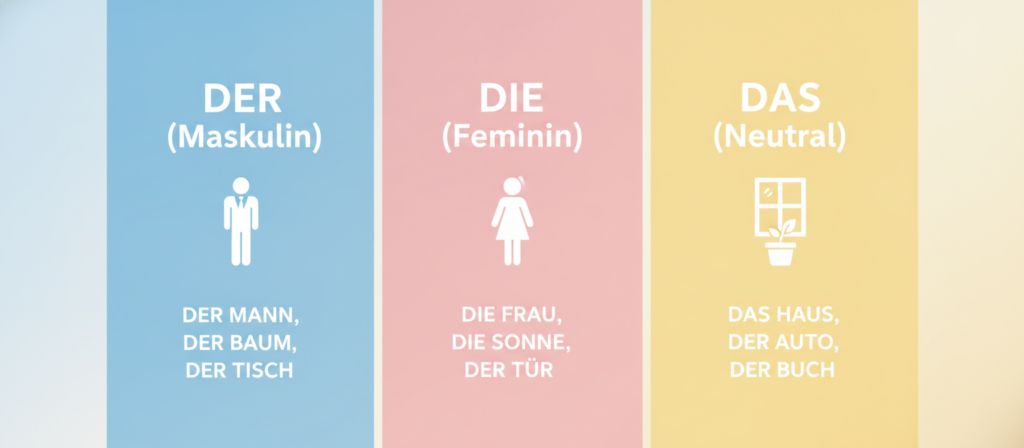
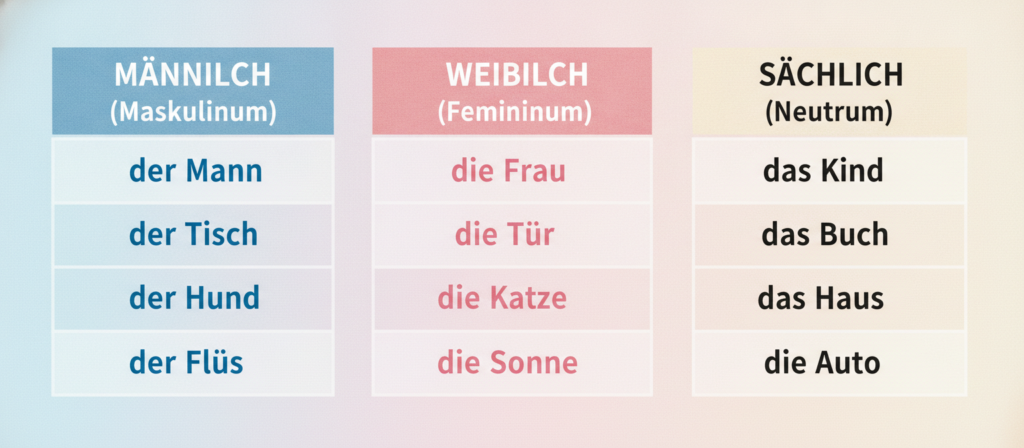
In German, nouns are grouped into three genders. In the nominative singular, der is used with masculine nouns, such as der Tisch (the table). Die is used with feminine nouns, such as die Lampe (the lamp). Das is used with neuter nouns, such as das Buch (the book).
These words all correspond to “the” in English. However, German definite articles also communicate information about a noun’s gender, case, and number. Their forms therefore change in different grammatical contexts.
Why Every German Noun Has a Gender
You might wonder why a table or another inanimate object has a gender. German gender rules do not follow biological logic. Instead, gender is a grammatical category within the language.
Even objects without natural gender, such as a spoon or chair, belong to a grammatical gender. Understanding this distinction makes the system easier to approach.
How Gender Impacts Sentences and Grammar
Noun gender in German affects more than the basic article. Together with case and number, it influences adjective endings, pronouns, and other words associated with the noun.
For instance, describing der Tisch and die Lampe can require different adjective endings because the nouns have different genders. Learning each noun with its gender from the beginning makes these later grammar rules easier to understand.
Step-by-Step Rules to Master Der, Die, and Das
Guessing German noun gender at random is not reliable. However, certain endings and semantic categories can help you make a more informed guess. Once you learn these clues, you’ll identify der, die, or das more accurately. Remember that some patterns are much more reliable than others.
How to Identify Masculine Nouns (Der)
Some masculine nouns end in -er, especially nouns referring to male people or occupations, such as der Lehrer (the male teacher). The endings -or, -ling, and -ismus are also commonly associated with masculine nouns, as in der Motor (the engine), der Frühling (spring), and der Tourismus (tourism).
Male people and male forms of professions usually take der. Der Vater (the father) and der Arzt (the male doctor) are examples.
Seasons, months, days of the week, and many weather-related words are also masculine. Examples include der Winter and der Montag. These categories can help you guess, but it is still best to check unfamiliar nouns because common endings such as -er and -en are not always reliable indicators on their own.
How to Identify Feminine Nouns (Die)
Feminine nouns often end in -e, -in, -heit, -keit, -ung, or -schaft. Die Blume (the flower) has the common -e ending, while die Freiheit (freedom) and die Zeitung (the newspaper) have highly reliable feminine suffixes.
Adding -in to many masculine profession or person nouns creates the corresponding feminine form. For example, der Lehrer becomes die Lehrerin.
Suffixes such as -heit, -keit, -ung, and -schaft make feminine nouns relatively easy to identify. The final -e is also a useful clue, although there are exceptions such as der Junge (the boy).
How to Identify Neuter Nouns (Das)
Neuter nouns often have diminutive endings such as -chen or -lein. Das Mädchen (the girl) and das Fräulein (a dated term historically meaning “young lady”) are examples.
Many nouns beginning with Ge- are neuter, including das Gebäude (the building) and das Geschenk (the gift). However, this is only a clue, not a universal rule.
Infinitives used as nouns are also neuter. Therefore, das Lesen (reading) and das Schwimmen (swimming) both take das.
Common Exceptions That Break the Rules
German has exceptions that can confuse even confident learners. Das Mädchen is neuter despite referring to a girl because the diminutive ending -chen always makes a noun grammatically neuter.
Der Junge (the boy) does not follow the common tendency for nouns ending in -e to be feminine. Das Auto (the car) is neuter without one of the most obvious neuter endings.
These examples show why patterns should be treated as useful clues rather than universal rules. Learn every new noun together with its article—for example, learn der Tisch rather than simply Tisch.
Simple Memory Tricks to Lock In Gender
Color-coding flashcards can be helpful. For example, use blue for der, red for die, and green for das. You can also connect each noun with an image in the same color to strengthen the association.
Mnemonic phrases and grouped suffixes can also improve recall. For example, remembering that nouns ending in -ung are feminine helps you recognize a dependable pattern over time.
These memory techniques make learning German gender rules more manageable and can help you retrieve the correct article during conversations.
Conclusion
Getting used to der, die, and das takes time, and that’s okay. The more you read, listen to, write, and speak German, the easier article choice will become. A little focused practice every day can make a meaningful difference.
Pay attention to noun endings and categories, but remain aware of exceptions. These patterns provide a useful starting point rather than a complete system. If you’re unsure, a German noun gender chart or dictionary can help until common combinations become familiar.
Using a chart with flashcards or a language-learning app makes practice more active. Regularly testing yourself on German articles can help move this knowledge into long-term memory. Personalised feedback is also useful because a teacher can identify recurring article and case errors that are difficult to notice independently. At Your Native Teacher, learners can work online with qualified teachers and practise German grammar in the context of their individual goals.
Mistakes are a normal part of learning, not a sign that you’re failing. Stay patient, keep practising, and der, die, and das will gradually feel more natural. This will improve both your accuracy and your confidence in speaking and writing.