


Ever downloaded an app full of promise, only to delete it three weeks later? You’re not alone in that frustration.
In 2026, there are many options for learning a new language. You can choose from self-study apps, live online lessons and blended learning programs. Finding the right approach can save you a lot of time and effort.
Not every option works in the same way. Some rely on gamified streaks to encourage regular practice.
Others focus on grammar, immersion or live conversation with a qualified teacher. Understanding these differences can help you take control of your learning.
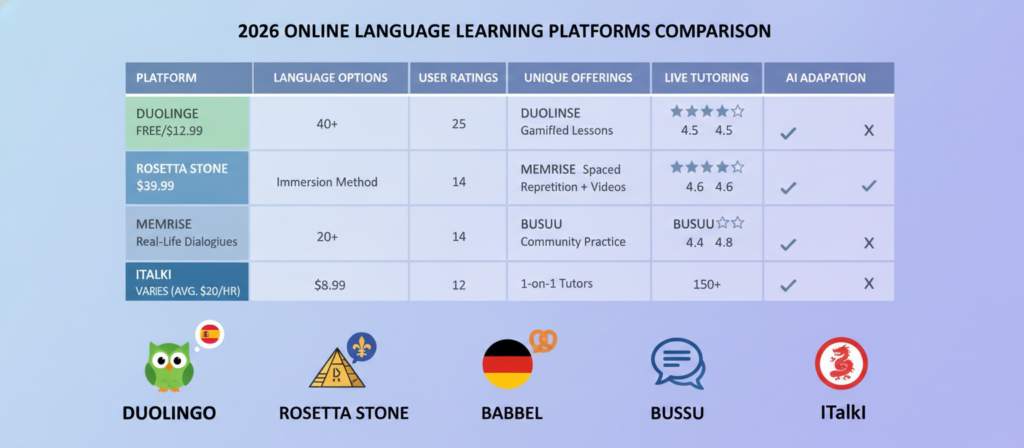
This guide compares four widely used language-learning apps—Duolingo, Babbel, Rosetta Stone and Busuu—with teacher-led online learning. You’ll see which approach may suit different goals and learning styles.
Whether you want basic travel phrases, business fluency or exam preparation, the best choice depends on the level of structure, feedback and speaking practice you need.
Key Takeaways
- Compare self-study apps and live online lessons before committing your time or money.
- Match your goals—such as travel, business communication or exam preparation—to the learning format that fits best.
- Gamified apps can suit casual learners who benefit from daily reminders and short practice sessions.
- Live lessons provide real conversation practice and personalised feedback from a teacher.
- Structured self-study courses can help learners build vocabulary and grammar, but they may not provide enough spontaneous speaking practice on their own.
- Features, teaching methods and payment models vary widely, so consider both your budget and your long-term goals.
- A combination of independent practice and teacher-led guidance is often more balanced than relying on one tool alone.
1. What to Look for Before Choosing a Language Learning App
Choosing the right language-learning tool is important, but price should not be the only factor. Your learning style, available time and goals matter too. Marketing claims and app-store ratings do not always show whether a resource will work for you.
What you need depends on your objectives. If you’re learning Spanish for a short trip, your priorities will differ from those of someone aiming to communicate confidently at work or prepare for an exam. Assess each option against your actual needs.
- Teaching methodology: Does the platform use games, a structured curriculum or lessons with a real teacher?
- Pricing model: Is there a monthly fee, a one-time cost or payment per lesson?
- Language support: Does it offer substantial instruction in your target language, or only a limited course?
- Offline access: Can you study without an internet connection?
- Speech-recognition quality: Does it provide useful pronunciation feedback, and can a teacher verify that feedback?
- Live human interaction: Will you speak with a real person or practise entirely on your own?
Choose according to how you learn, not simply how an app looks. Short, gamified sessions may support consistency, while structured lessons or live conversations may be more appropriate for learners who need detailed explanations and individual feedback.
| Criterion | Why It Matters | Question to Ask Yourself |
|---|---|---|
| Teaching Methodology | Influences pace, depth and whether you develop conversational ability or mainly memorise words and phrases | Do you want gamified practice, structured lessons or live teaching? |
| Pricing Model | Affects long-term cost and flexibility if your schedule or budget changes | Can you commit to a subscription, or would you prefer paying per lesson? |
| Speech Recognition | Can support pronunciation practice, although automated feedback has limitations | Does the platform provide specific, useful feedback on your speech? |
| Live Interaction | Helps bridge the gap between controlled app exercises and spontaneous real-world conversation | Do you need personalised guidance from a teacher, or is self-paced practice enough for your current goal? |
| Offline Access | Determines whether you can study consistently while travelling or without a reliable connection | Will you need to learn during commutes, travel or periods with limited internet access? |
2. Online Language Learning Options Compared
Choosing the right language-learning platform depends on what you want to achieve. Some apps focus on quick, independent practice, while live online lessons provide direct guidance and real conversation. The options below illustrate the main differences.

2.1 Duolingo
Overview
Duolingo is a well-known language-learning app offering short exercises designed to fit into a busy day. It is most useful as a supplementary resource for regular vocabulary and sentence practice.
Key Features
- Gamified lessons with streaks and rewards
- A broad selection of language courses
- Speaking, listening, reading and writing exercises
Pros
- A free tier that provides access to substantial learning content
- Short, low-pressure exercises that can appeal to beginners
Cons
- Limited depth for advanced communication and spontaneous conversation
- Advertisements and feature restrictions may affect the free experience
2.2 Babbel
Overview
Babbel uses structured self-study lessons based on everyday situations. It may be useful for practising common phrases and reviewing basic grammar independently.
Key Features
- Conversation-based lesson structure
- Speech-recognition exercises
- Grammar and culture-related content
Pros
- Practical vocabulary for common situations
- Clear, easy-to-follow lesson structure
Cons
- A more limited language selection than some other apps
- Most course access requires payment
2.3 Rosetta Stone
Overview
Rosetta Stone is known for an immersive method that introduces language through images and context rather than frequent direct translation.
Key Features
- Immersive, translation-light learning method
- Automated speech-recognition practice
- Subscription and longer-term access options, depending on the plan
Pros
- Regular pronunciation practice
- Consistent visual teaching method
Cons
- The method may feel slow or repetitive to some learners
- Automated exercises cannot fully replace individual correction from a teacher
2.4 Busuu
Overview
Busuu combines structured self-study activities with community feedback. This can give learners additional opportunities to receive comments on selected writing or speaking exercises.
Key Features
- Community feedback on some writing and speaking tasks
- Personalised study-plan features
- Course-completion and progress features on eligible plans
Pros
- Community feedback can add a human element to independent practice
- Structured lessons for regular self-study
Cons
- Feedback availability and quality can vary by language and community activity
- Community corrections are not the same as structured feedback from a qualified teacher
2.5 Your Native Teacher
Overview
Your Native Teacher offers live online lessons with real, qualified teachers. This teacher-led format is suitable for learners who need personalised guidance, speaking practice, business-language training or focused exam preparation.
Key Features
- Live online lessons with qualified teachers
- Personalised instruction based on the learner’s goals and level
- Real-time speaking practice, explanations and corrective feedback
Pros
- Individual guidance that can adapt to specific strengths and weaknesses
- Useful for conversation, professional communication and structured preparation
Cons
- Live lessons require scheduling
- Teacher-led learning requires more active participation than short app exercises
| Option | Best For | Standout Feature | Learning Model |
|---|---|---|---|
| Duolingo | Casual daily practice | Gamified exercises | Free and paid self-study options |
| Babbel | Structured independent study | Everyday dialogues | Paid self-study access |
| Rosetta Stone | Immersion-style practice | Context-based method | Subscription or longer-term access |
| Busuu | Self-study with community input | Community corrections | Free and paid self-study options |
| Your Native Teacher | Personalised speaking, exam or business-language support | Live lessons with qualified teachers | Teacher-led online learning |
3. Which Learning Option Matches Your Goals?
The right language-learning option depends on your goals, schedule, budget and current level. Use the situations below to identify the type of support you are likely to need.
3.1 If You’re a Complete Beginner
A gamified language-learning app can make language learning for beginners feel accessible. Short exercises can help you establish a routine and begin learning essential vocabulary.
However, app practice is more effective when you also receive clear explanations and feedback. A qualified teacher can help you understand pronunciation, sentence structure and common mistakes before they become habits.
3.2 If You’re a Busy Professional
Short app-based activities can support self-paced language learning during a busy week. They are useful for reviewing vocabulary or completing brief listening and grammar exercises.
If you need the language for meetings, presentations, emails or negotiations, personalised business-language lessons can provide more relevant practice. At Your Native Teacher, learners can work online with qualified teachers and receive guidance based on their professional goals.
3.3 If You Want Full Immersion
Immersion-style tools can help you associate words with images, situations and meaning rather than translating every sentence. This can encourage you to process the target language more directly.
For a more complete form of language immersion, combine independent listening and reading with regular conversation. A teacher can introduce natural expressions, ask unpredictable questions and correct misunderstandings in context.
3.4 If You Need Live Conversation Practice
Choose live online lessons if your priority is speaking practice with a teacher. One-to-one instruction gives you opportunities to respond spontaneously, ask questions and receive immediate feedback.
This can help you identify recurring mistakes and develop more accurate, confident communication. Apps can still be useful between lessons for vocabulary review and additional listening practice.
4. Conclusion
No single app or platform is best for everyone. Duolingo, Babbel, Rosetta Stone and Busuu offer different forms of independent practice, while live online lessons provide personalised teaching and direct interaction. Your goals, schedule and learning style should guide your choice rather than rankings alone.
If you want to learn a new language online, begin with a sustainable routine. A free or low-commitment app can help you explore a self-study method, but consider whether you also need structured explanations, speaking practice or individual feedback.
Think about the balance that suits you. Short exercises can support consistency, structured courses can organise your independent study, and live lessons can address your specific needs. These formats do not have to be mutually exclusive.
Choose a realistic approach, practise consistently and review your progress regularly. If you need personalised support, Your Native Teacher offers live online lessons with qualified teachers who can adapt the learning plan to your goals.