




Ever nod along in a conversation, then quietly panic because you missed the last sentence? That awkward pause happens to more learners than you might think.
Years of grammar drills and flashcards can build a strong vocabulary. Yet spoken conversations often move too fast to follow. Words blend together, accents vary, and speakers rarely pause so you can catch up.
This guide breaks down practical methods to sharpen your ear for spoken English. You’ll explore how podcasts, shadowing techniques, and casual conversation practice can train your brain to process speech more naturally.
By the end, you’ll have a clear roadmap towards stronger listening comprehension and greater confidence in real conversations.
Key Takeaways
- Consistent daily practice trains your brain to process spoken language more efficiently.
- Podcasts and audio dramas expose you to natural speech patterns and regional accents.
- Shadowing techniques help you imitate rhythm, stress, and pronunciation in real time.
- Conversation practice builds confidence and quicker comprehension.
- Tracking your progress keeps motivation high and highlights areas to improve.
- A structured approach turns passive hearing into active understanding.
Why Listening Skills Are Key to Mastering English
Have you ever noticed how easily you can read English but struggle to catch what someone has just said?
This highlights a common challenge: listening comprehension is essential for real communication. Good English listening skills help you follow conversations, enjoy films or podcasts with fewer subtitles, and communicate more effectively in job interviews or business meetings.
Many ESL learners spend hours on grammar and vocabulary but devote less time to listening practice. This can create a frustrating gap between what you can read and what you understand when someone speaks to you directly.
Improving your ESL listening skills does more than help you understand words. It can boost your confidence and support your speaking development. By listening carefully to spoken English, you become more familiar with pronunciation, rhythm, stress, and intonation.
Step-by-Step Ways to Improve English Listening
Ready to improve your English listening skills? Follow these six steps to develop your understanding of spoken English. Start with manageable material and work your way towards more challenging speech.
With regular practice, you should gradually begin to understand more during conversations, films, and everyday interactions.
1. Choose Podcasts Made for English Learners
Podcasts are useful for improving your listening skills. You can listen during your commute, while cooking, or before bed. Many English podcasts for learners use clear speech and explain unfamiliar words.
Look for podcasts with transcripts. Reading along can help you connect sounds with spelling. Educational programmes from established broadcasters and learner-focused podcast series are good places to start.
Best Podcast Genres to Start With
Begin with these genres:
- News summaries with accessible vocabulary
- Storytelling podcasts with clear narration
- Interview shows with measured speech
- Grammar and vocabulary lessons
2. Watch Films and TV Shows with Subtitles
Watching films and television programmes with subtitles can support listening practice. Facial expressions, actions, and settings also provide clues to meaning.
Choose programmes that match your interests and level. Content with everyday dialogue and clear audio is often easier to follow than fast-paced dramas with specialised vocabulary.
English Subtitles vs. Native Language Subtitles
The most useful subtitle choice depends on your current level and learning goal.
| Aspect | English Subtitles | Native Language Subtitles |
|---|---|---|
| Vocabulary building | Reinforces English spelling and word recognition | Helps beginners understand the overall meaning |
| Listening focus | Helps connect English sounds with written words | May shift attention towards translation |
| Best for level | Often useful for intermediate and advanced learners | Can support beginners when content is difficult |
| Long-term use | Can support direct processing in English | Best reduced gradually as comprehension improves |
Try switching to English subtitles when you can follow the main plot. Later, rewatch short scenes without subtitles to test your listening comprehension.
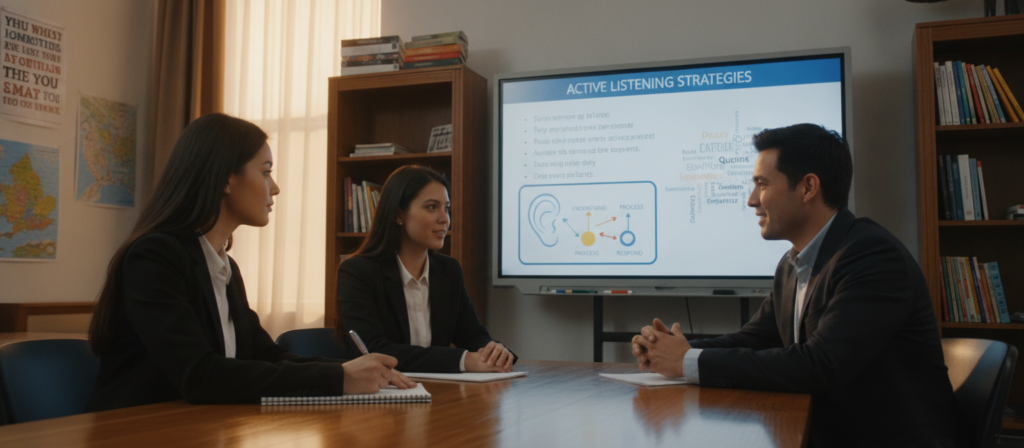
3. Practice Active Listening Every Day
Don’t just listen passively. Active listening means focusing closely on what you hear.
Pause to summarise the main idea, write down key words, or ask yourself questions about the speaker’s tone and message. You can also transcribe a short section and compare it with the original transcript.
Short, focused sessions are often more useful than long periods of background listening. Regular practice helps you build familiarity with spoken English.
4. Use the Shadowing Technique
The shadowing technique involves repeating what you hear almost immediately. Try to match the speaker’s pace, stress, and pronunciation.
Start with a 30-second clip. Listen carefully several times, then speak along with the recording. If the clip is too fast, practise one sentence at a time before attempting the full section.
This method can develop both listening and speaking skills by helping you notice connected speech and natural rhythm.
5. Join Conversation Groups or Language Exchanges
Real conversations are often less predictable than scripted audio. A language exchange or conversation group can give you experience with spontaneous speech.
Look for a well-moderated local group or online language-exchange platform. Many exchanges are mutual, allowing both partners to practise.
For structured practice and personalised correction, you can also work with a qualified teacher. At Your Native Teacher, learners can take live online lessons focused on their listening challenges, speaking goals, and preferred topics.
Whichever option you choose, regular conversation can build confidence and expose you to a wider range of accents, expressions, and speaking styles.
6. Track Your Progress and Increase Difficulty Gradually
Keep a log of what you listen to each week and note how much you understood. Reviewing this record can help you recognise progress and identify recurring difficulties.
Once something feels comfortable, move to slightly faster speech or more complex topics. Increasing the difficulty gradually keeps you challenged without making practice unnecessarily frustrating.
Conclusion
Building strong listening skills takes time, but regular practice can make spoken English easier to process. Techniques such as learner-friendly podcasts, active listening, and shadowing work best when used consistently.
Don’t get discouraged by fast speech or unfamiliar accents. Your brain needs time and repeated exposure to become familiar with new sounds and patterns.
As your skills develop, conversations may become clearer and you may rely less on subtitles. Progress varies from person to person, so focus on consistent improvement rather than a fixed deadline.
Start with one method today, such as listening to a short podcast or shadowing a brief recording. Small, steady steps can improve your listening skills over time.