


Ever wondered when you’ll be able to speak French confidently in Paris? The truth is that there’s no one-size-fits-all answer, but realistic estimates can help you plan your learning journey.
Your timeline depends on where you start, how much you study each week, and what you want to achieve. You might be preparing for a trip, studying for an exam, moving for work, or aiming for advanced fluency.
Regular exposure to the language can make a significant difference. Combining structured study with frequent listening and speaking practice may help you progress faster than relying on occasional lessons alone.
Here’s some encouragement: the Foreign Service Institute places French in Category I for English-speaking learners, meaning it is generally considered more accessible than languages such as Mandarin or Arabic. However, real improvement still requires sustained time and effort, not just a weekend of intensive study.
This guide explains how you can progress step by step using the CEFR framework. You’ll also find practical ways to improve your skills efficiently.
You’ll understand what realistic progress looks like, without false promises or shortcuts.
Ready to explore your timeline level by level?
Key Takeaways
- No single timeline fits every student; your pace depends on the hours you invest, your starting level, and your personal goals.
- French is generally considered relatively accessible for English speakers because the languages share a substantial amount of vocabulary.
- Reaching genuine fluency requires consistent effort over many months or years, not a rushed weekend.
- Regular weekly practice matters more than elapsed calendar time; consistent habits support genuine progress.
- Structured immersion, qualified teacher support, and intensive study can help learners progress more efficiently than casual self-study alone.
- Your goal—whether travel, exams, relocation, work, or advanced fluency—determines which CEFR level you need.
How Long to Learn French: Timeline by Skill Level
Learning French at your own pace is normal, but the CEFR French levels provide a useful way to track your progress. The Common European Framework of Reference for Languages describes ability from A1 at beginner level to C2 at highly proficient level. CEFR levels are widely used by schools, employers, exam providers, and language institutes across Europe, although individual qualifications do not always map perfectly to a single CEFR level.
Your French fluency timeline depends on your weekly study time, the quality of your practice, and your exposure to proficient speakers. The estimates below are planning benchmarks rather than guaranteed completion times.
Basic Conversational French (A1-A2)
Reaching basic conversational ability may take approximately 150 to 200 hours of focused study, although estimates vary. At four to five hours a week, that represents roughly seven to twelve months of consistent learning. More intensive learners may progress sooner.
At this level, you can handle familiar everyday situations. You may be able to introduce yourself, order food, ask for directions, and manage simple travel interactions.
This range broadly overlaps with the skills developed during school-level French study, though exact GCSE expectations vary by course and assessment. You won’t yet be fluent, but you can build a useful functional foundation.
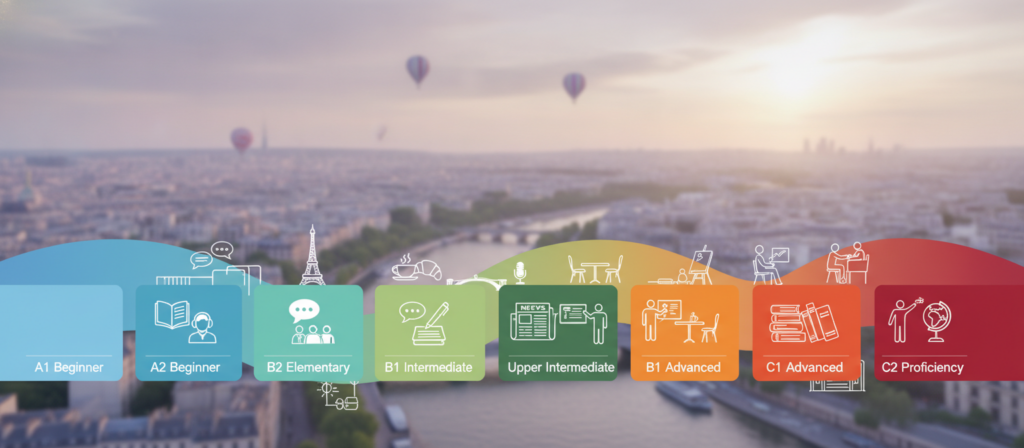
Intermediate Fluency (B1-B2)
Intermediate ability often requires a larger commitment, with rough estimates of 350 to 600 cumulative hours. Many learners reach this range after one to two years of regular study, although weekly intensity and previous language-learning experience make a major difference.
This is the level many learners target when moving to France or working with French-speaking colleagues. Depending on whether you are at B1 or B2, you may be able to participate in work-related conversations, follow the main points of French news, and explain your opinions with increasing accuracy.
Parts of the B1-B2 range may overlap with the skills expected in advanced school qualifications, although the exact comparison depends on the course and the learner’s performance. At this stage, French begins to feel like a practical tool rather than only a subject you study.
Advanced and Highly Proficient French (C1-C2)
Advanced proficiency sits at the top of the CEFR French levels and may require 700 to 1,000 or more hours of focused learning and practice. Many learners need two to four years or longer to reach this range.
At C1-C2, learners can engage with complex topics, understand nuance, follow demanding texts, and communicate effectively in academic or professional settings. Some professions, including interpreting and diplomacy, may require advanced language ability alongside specialist training and qualifications.
Few casual learners need to reach C2, but advanced proficiency is achievable through sustained exposure, structured learning, detailed feedback, and extensive real-world use.
| CEFR Level | Estimated Cumulative Hours | Possible Timeframe | Core Skills |
|---|---|---|---|
| A1-A2 (Basic) | 150-200 hours | Approximately 7-12 months at 4-5 hours weekly | Greetings, travel, and simple conversations |
| B1-B2 (Intermediate) | 350-600 hours | Often 1-2 years of regular study | Work discussions, media comprehension, and expressing opinions |
| C1-C2 (Advanced) | 700-1,000+ hours | Often 2-4+ years | Complex discussion, literature, and professional writing |
Remember that these figures are approximate benchmarks, not strict guarantees. Your previous language experience, immersion opportunities, study methods, and weekly intensity can all affect your French fluency timeline.
The best French learning tips often return to one idea: consistency matters. Steady weekly practice, even in relatively short sessions, tends to be more effective than sporadic cramming.
Step-by-Step Guide to Learning French Faster
A clear roadmap turns language-learning theory into measurable progress. The five steps below provide a practical action plan for developing your French efficiently, whether you’re just starting or working toward advanced skills.
Step 1: Set Clear and Realistic Goals
Vague ambitions such as “get better at French” are difficult to measure. Specific goals give you a clear target and make it easier to choose suitable learning activities.
For example, you might aim to hold a 10-minute conversation within three months. Connecting your goals to CEFR skills can also help you understand where you are and what to work on next.
- A1-A2 goal example: Order food and ask for directions confidently during an upcoming trip.
- B1-B2 goal example: Discuss a familiar current event with a proficient speaker for 15 minutes, with manageable pauses.
- C1-C2 goal example: Write a persuasive essay or deliver a detailed presentation entirely in French.
Step 2: Choose the Right Learning Method
Learners have many options, and the right combination depends on your budget, schedule, level, and preferred learning style. Group courses can provide structure and accountability, while language-learning apps are useful for short daily vocabulary or grammar exercises.
For personalised speaking practice and detailed feedback, live online lessons with a qualified teacher can provide structure that self-study tools cannot. At Your Native Teacher, learners can work online with qualified teachers and receive guidance based on their goals, level, and learning needs. Textbooks, podcasts, and practice apps can then supplement those lessons between sessions.
| Method | Best For | Main Benefit | Time Commitment |
|---|---|---|---|
| Group language courses | Learners seeking a fixed syllabus and group accountability | Structured progression with peer interaction | Usually 2-4 hours weekly |
| Language-learning apps | Busy beginners building a daily habit | Short vocabulary and grammar exercises | 10-20 minutes daily |
| Live online lessons with a qualified teacher | Personalised speaking practice, exam support, and feedback | Individual guidance and correction | Often 1-3 sessions weekly |
| Self-study textbooks | Independent, grammar-focused learners | Systematic reference and written practice | Flexible and self-paced |
Step 3: Practice Speaking Regularly
Daily French practice can be especially valuable when your goal is to speak confidently. Reading grammar explanations builds knowledge, but speaking helps you retrieve vocabulary, form sentences, and improve pronunciation in real time.
Start French speaking practice early, even if you know only a handful of words. Aim for consistency rather than perfection, and seek corrective feedback so that repeated mistakes do not become habits.
- Use language-exchange platforms for additional informal practice, while treating them as a supplement rather than a substitute for structured teaching.
- Join a local conversation club or French-speaking community group.
- Record yourself speaking for two minutes, then listen for pronunciation or vocabulary gaps.
- Repeat useful phrases aloud from your lessons instead of reading them only silently.
- Schedule regular conversations with a qualified teacher who can correct errors and adapt practice to your level.
Step 4: Immerse Yourself in French Culture
French immersion techniques can support faster progress by increasing the amount of meaningful contact you have with the language. Regular exposure helps your brain process French more directly instead of translating every sentence word by word.
UK residents may also be able to visit France relatively easily. Even a short trip can create useful opportunities to apply familiar phrases in authentic situations, although travel is not essential for effective immersion.
- Watch French films and TV programmes, gradually reducing your reliance on subtitles as your comprehension improves.
- Listen to French podcasts during your commute or workout.
- Join French cultural societies or local conversation groups.
- Switch selected phone or social media settings to French for regular, low-effort exposure.
Step 5: Track Your Progress and Stay Consistent
Motivation can fade when progress is difficult to see. Tracking your learning helps you stay accountable and recognise improvements that might otherwise go unnoticed.
Keep a simple learning journal to record new vocabulary, useful corrections, and grammar achievements each week. Spaced-repetition tools can also help you review vocabulary at gradually increasing intervals instead of relying on one-time memorisation.
- Take a CEFR-aligned practice assessment periodically to identify strengths and gaps.
- Set monthly checkpoints to review the goals from Step 1 and adjust them when necessary.
- Celebrate practical wins, such as understanding a short French conversation or completing a task without switching to English.
Following these five steps can turn scattered effort into steady, trackable progress toward your chosen level of French.
Conclusion
Learning French is a long-term skill-building process with recognisable stages. You now have a clearer idea of what to expect, from your first “bonjour” to confident conversations and advanced communication.
The best way to learn French depends on your goals, but the core principles are consistent: set realistic targets, use suitable resources, practise regularly, and get meaningful feedback. Apps and self-study materials can reinforce vocabulary and grammar, while live lessons provide guided speaking practice and personalised correction.
If you’re starting, focus on small wins. Learn greetings, basic questions, and everyday phrases first. Progress builds over time, making increasingly complex tasks more manageable.
You do not need to wait for the perfect time to begin. Say one French sentence aloud, listen to a short piece of French audio, or review a few useful phrases today. Small, consistent actions can produce substantial progress over time.
If you want a structured plan and personalised support, Your Native Teacher offers live online French lessons with qualified teachers. A teacher can help you identify your current level, correct recurring mistakes, and focus your study time on the skills that matter most to your goals.