



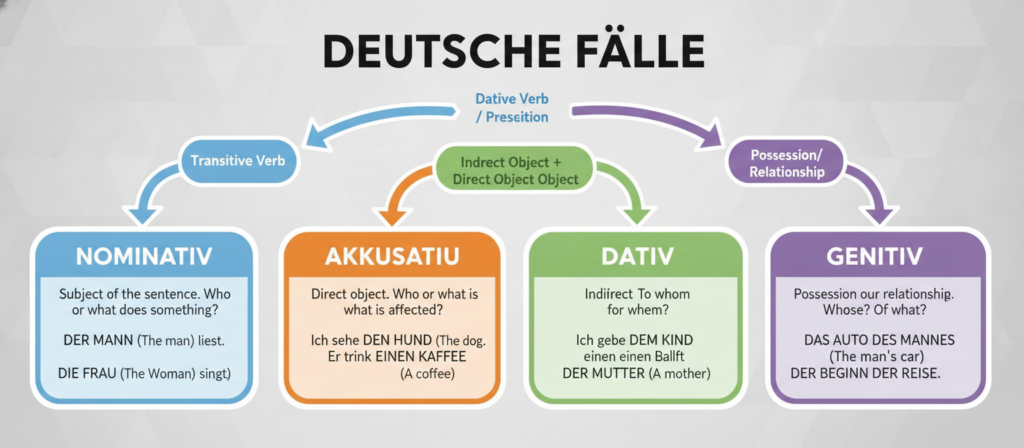
Ever wondered why “der” turns into “den” in a sentence? This change is a key part of the German case system, and it is a common hurdle for learners.
Once you grasp this system, German sentence structure becomes clearer. Article forms, adjective endings and some noun endings follow recognisable patterns.
This guide simplifies the nominative, accusative, dative and genitive cases. It uses real-life examples and practical tips you can apply immediately. Each section builds on the last, keeping the topic straightforward.
You’ll also learn to avoid common mistakes that English speakers often make. By the end, you should feel more confident identifying and using German cases.
Key Takeaways
- The case system shows the role of a noun or pronoun in a sentence and affects articles, adjectives and some noun endings.
- Learning all four cases step by step makes the topic far less overwhelming.
- Real-life examples help you apply grammar rules naturally in conversation and writing.
- Spotting common mistakes early prevents bad habits from forming.
- Mastering this area of grammar leads to clearer, more accurate communication.
- A structured approach turns a confusing subject into a manageable one.
1. Understanding the Basics of the German Case System
Ever wondered why German articles change form? It is all about the grammatical case system. This system might seem unfamiliar at first, but it becomes more logical once you understand it. Knowing the basics will help you grasp German grammar much faster.
1.1 What Is a Grammatical Case?
A grammatical case shows a noun’s role in a sentence. The noun could be the subject, direct object, indirect object or part of a possessive relationship. German uses article forms, pronouns and word endings to help mark these roles.
English relies heavily on word order to convey meaning. For example, “The dog bites the man” is different from “The man bites the dog.” The words are the same, but their roles and the meaning change when the order changes.
German word order can be more flexible because the case system helps mark each noun’s role directly. This does not mean that word order is unrestricted, but cases allow German speakers to change the emphasis without necessarily changing who is doing what. It might feel strange at first, but it becomes more natural with practice.
1.2 Why German Uses Four Cases
German has four cases: nominative, accusative, dative and genitive. Each case has particular functions, making the system precise and adaptable.
The German nominative case usually marks the subject. The German accusative case often marks the direct object. The German dative case can mark an indirect object and is also required by certain verbs and prepositions.
The genitive case commonly expresses possession or a relationship between nouns, similar to English constructions with “of” or an apostrophe and “s.” These four cases help keep grammatical relationships clear, even when sentence order changes for emphasis.
| Case | Function | Sample Question | Example |
|---|---|---|---|
| Nominative | Usually marks the subject | Who or what? | Der Mann liest. (The man reads.) |
| Accusative | Often marks the direct object | Whom or what? | Ich sehe den Mann. (I see the man.) |
| Dative | Often marks the indirect object | To or for whom? | Ich gebe dem Mann ein Buch. (I give the man a book.) |
| Genitive | Often shows possession or a relationship | Whose? | Das Buch des Mannes. (The man’s book.) |
Notice how the article and, in some cases, the noun ending change with each case. These patterns are central to understanding German grammar. Recognising them makes reading, writing and speaking German much easier and prepares you for a more detailed breakdown of each case.
2. German Cases Explained: A Step-by-Step Breakdown
Now that you know the basics, let’s explore the four cases in German. Each case helps explain a noun’s role, although certain verbs and prepositions also determine which case you need. Learning the main patterns makes it easier to form sentences.
Below, you’ll find each case broken down with examples and article changes. This will help you see the patterns in action.
2.1 Nominative Case: The Subject of the Sentence
The nominative case usually marks the subject—the person or thing performing the action. It answers the question “who?” or “what?” This case uses the dictionary form of the definite article, making it a useful starting point for learning German articles.
For example: Der Hund läuft. (“The dog runs.”) Since “der Hund” performs the action, it takes the nominative article “der.”
- Der Mann arbeitet. (The man works.)
- Die Frau liest. (The woman reads.)
- Das Kind spielt. (The child plays.)
2.2 Accusative Case: The Direct Object
The accusative case often identifies the direct object—the noun directly affected by the verb’s action. It answers “whom?” or “what?” Here, German articles start to change, especially for masculine nouns.
Notice how “der” changes to “den”: Ich sehe den Hund. (“I see the dog.”) Feminine, neuter and plural definite articles remain the same as in the nominative case.
- Ich kaufe den Apfel. (I buy the apple.)
- Sie liebt die Katze. (She loves the cat.)
- Wir sehen das Haus. (We see the house.)
2.3 Dative Case: The Indirect Object and More
The dative case often marks the indirect object, such as the person receiving something. It can answer “to whom?” or “for whom?” However, certain verbs and prepositions also require the dative even when there is no obvious recipient. German articles change noticeably here, so pay close attention as you practise.
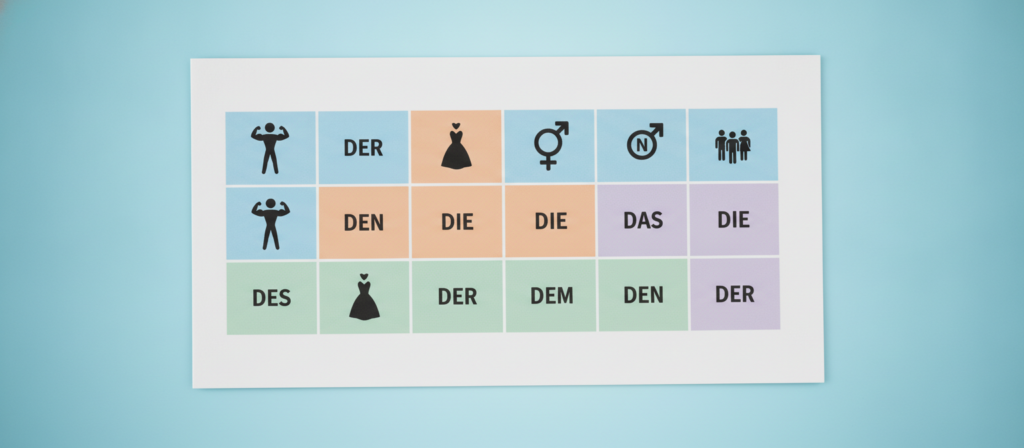
Masculine “der” becomes “dem,” feminine “die” becomes “der,” and neuter “das” also becomes “dem.” For example: Ich gebe dem Mann das Buch. (“I give the book to the man.”) The dative plural article is “den,” and the plural noun usually takes an additional -n when it does not already end in -n or -s.
- Ich helfe der Frau. (I help the woman.)
- Er dankt dem Lehrer. (He thanks the teacher.)
- Sie schreibt den Kindern. (She writes to the children.)
2.4 Genitive Case: Showing Possession
The German genitive case, which learners often find tricky, usually shows possession or a relationship between two nouns. It works somewhat like an apostrophe and “s” or an “of” construction in English, but it has its own article and noun-ending rules.
Masculine and neuter nouns typically add -s or -es, while their definite articles both change to “des.” The feminine and plural definite article becomes “der.”
For example: Das Auto des Mannes ist neu. (“The man’s car is new.”) This construction is especially common in formal and written German. In everyday speech, possession is also frequently expressed with von followed by the dative.
- Die Farbe des Hauses ist blau. (The colour of the house is blue.)
- Der Name der Frau ist Anna. (The woman’s name is Anna.)
- Die Titel der Bücher sind lang. (The titles of the books are long.)
| Case | Masculine | Feminine | Neuter | Plural |
|---|---|---|---|---|
| Nominative | der | die | das | die |
| Accusative | den | die | das | die |
| Dative | dem | der | dem | den |
| Genitive | des | der | des | der |
Mastering these German case forms takes repetition, but the definite-article pattern is consistent. Keep this table handy while building sentences, and the article changes will gradually become more automatic.
3. Practical Tips to Master German Cases Faster
Many students memorise case charts but struggle to apply them while speaking. This gap is normal. A few focused habits can make German grammar easier to use with confidence.
Here are practical strategies to master German cases. You’ll learn to spot errors and build useful daily habits.
3.1 Common Mistakes to Avoid
Many learners make similar mistakes. Recognising them early can save time later.
Here are some common mistakes and quick corrections:
| Common Mistake | Incorrect Example | Correct Example |
|---|---|---|
| Using the dative after an accusative preposition | Ich gehe durch dem Park. | Ich gehe durch den Park. |
| Forgetting the adjective ending | Ich sehe das rot Auto. | Ich sehe das rote Auto. |
| Using the wrong article after a dative preposition | mit der Bruder | mit dem Bruder |
| Using the wrong case after “von” | Das Auto von mein Vater | Das Auto von meinem Vater |
Small changes in article and adjective endings clarify each word’s grammatical role. Practising these changes aloud can help the correct patterns become more familiar.
3.2 Easy Tricks for Remembering Article Endings
Article forms can seem difficult at first, but a few techniques make them easier to remember. These strategies turn abstract grammar rules into patterns you can see and hear.
- Colour-code by case: Use a different colour for each case—blue for nominative, red for accusative, green for dative and yellow for genitive—and apply the system consistently in your notes.
- Use rhythm and rhyme: Reciting sequences such as “der, den, dem, des” rhythmically can help you remember masculine definite articles.
- Create mini flashcards: Write one sentence per card and quiz yourself on the correct article.
- Group prepositions by case: List prepositions that always take the accusative, such as durch, für and gegen, separately from those that always take the dative, such as aus, bei and mit.
Visual cues, sound patterns and repeated examples can make the forms easier to recall. These techniques work best when used regularly.
3.3 Practising with Real-Life Sentences
Grammar rules can feel abstract until you use them in context. One effective way to learn is to practise sentences from everyday situations rather than relying only on isolated drills.
Try making short scripts for situations such as these:
- Ordering food: “Ich möchte einen Kaffee, bitte.” (accusative)
- Giving directions: “Gehen Sie bis zur Ampel.” (dative after zu)
- Describing your day: “Nach der Arbeit gehe ich nach Hause.” (dative after nach)
- Talking about belongings: “Das ist die Tasche meiner Schwester.” (genitive)
Repeat these sentences aloud, then change the nouns to test yourself. Personalised feedback from a qualified teacher can also help you identify case errors that are difficult to notice on your own. At Your Native Teacher, learners can practise German online with a teacher and receive guidance based on their individual goals.
4. Conclusion
Learning the four German cases is an important step towards understanding German sentences. Once you see how the nominative, accusative, dative and genitive work together, grammatical relationships become clearer.
Wondering how to learn German cases? Focus on regular practice rather than memorisation alone. Read real sentences, identify the case of each relevant noun and check your answer against a German case chart. Over time, the patterns will become more familiar.
Making mistakes is a normal part of learning. Small case errors often do not prevent communication, but correcting them gradually will make your German clearer and more accurate.
Keep your German case chart handy while studying or writing. It can help you check uncertain forms until you can recall them without support.
Return to the tips on common mistakes whenever you struggle with a sentence. Grammar skills develop gradually, and each focused review strengthens your understanding.
Your progress will show in small ways, such as choosing “den” correctly or recognising a dative preposition. Be patient, practise often and approach German cases one step at a time.