


Ever wondered why some people make rapid progress in Spanish while others study for years? It is not magic. Progress depends on strategy, consistency, previous experience and what you want to achieve.
“It depends” is a common answer, but it is not especially helpful on its own. In this guide, you will find realistic estimates and practical steps for building conversational or professional Spanish skills.
The U.S. Foreign Service Institute (FSI) places Spanish in Category I for English-speaking learners. Its often-cited estimate is approximately 600 to 750 classroom hours to reach professional working proficiency under intensive training conditions. This is a useful reference point, but independent learners may progress faster or slower depending on their goals, learning environment and opportunities to practise.
This guide will help you adapt your learning plan to your needs. You will get a roadmap from beginner to advanced levels, along with practical ways to start speaking sooner.
Key Takeaways
- Professional working proficiency may require around 600–750 classroom hours under intensive training conditions, although individual timelines vary.
- The Foreign Service Institute classifies Spanish as a Category I language for English speakers.
- Consistent daily practice is generally more effective than occasional cramming sessions.
- Your timeline depends on factors such as previous language experience, study methods, weekly study time and immersion opportunities.
- Effective learning strategies can help you make steady progress and start communicating sooner.
- Setting realistic milestones can help you stay motivated throughout your learning journey.
1. Key Factors That Affect How Long It Takes to Learn Spanish
Learning Spanish is not just about reaching one final goal. Some learners want to handle basic travel situations, while others need Spanish for work, study or complex conversations. Four main factors influence how quickly you are likely to progress.
1.1 Your Target Fluency Level
What you mean by “fluent” matters. Simple tasks such as ordering food require much less time than discussing complex ideas, working in Spanish or reading advanced literature.
Before you begin, decide what you want to achieve. This will help you choose suitable Spanish learning methods and focus your time effectively.
1.2 Weekly Time Commitment
Following a regular routine is usually more effective than studying intensively only once in a while. A manageable amount of daily practice can help you retain vocabulary and build confidence.
The FSI estimate of approximately 600–750 classroom hours provides one reference point for professional working proficiency, but it should not be treated as a universal requirement. Consider how many hours you can realistically study and practise each week when estimating your own timeline.
1.3 Prior Language Learning Experience
If you have learned another language before, you may already understand how to study vocabulary, recognise grammar patterns and manage the challenges of communicating with limited knowledge.
English speakers who know another Romance language, such as French or Italian, may find some aspects of Spanish easier because these languages share vocabulary and certain grammatical features.
1.4 Immersion vs. Classroom Learning
Structured lessons can provide a strong foundation in grammar, vocabulary and pronunciation, but learners also need opportunities to use the language. Spanish immersion learning increases exposure and encourages you to retrieve what you know in realistic situations.
Living in a Spanish-speaking environment is one form of immersion, but it is not the only option. You can also join conversation groups, watch Spanish-language media, use online practice tools and speak regularly with a teacher or language partner. Combining structured learning with frequent practical use is often the most balanced approach.
2. How Long to Learn Spanish: A Step-by-Step Timeline to Fluency
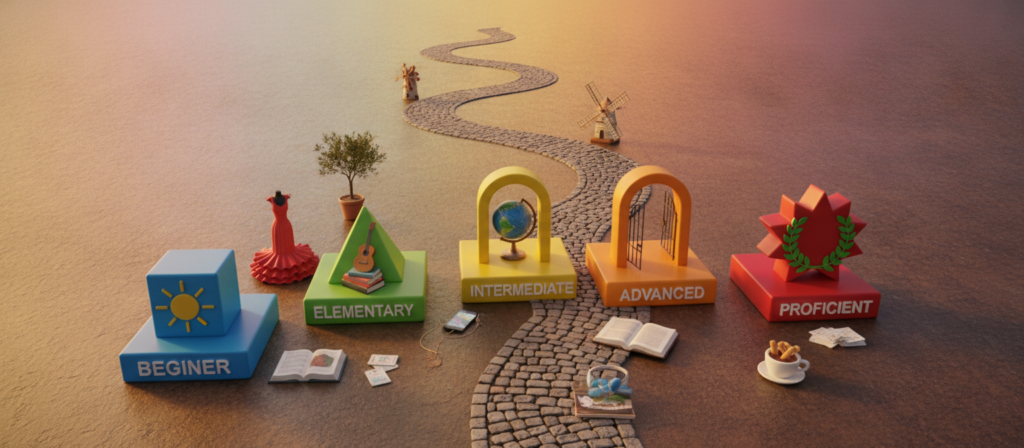
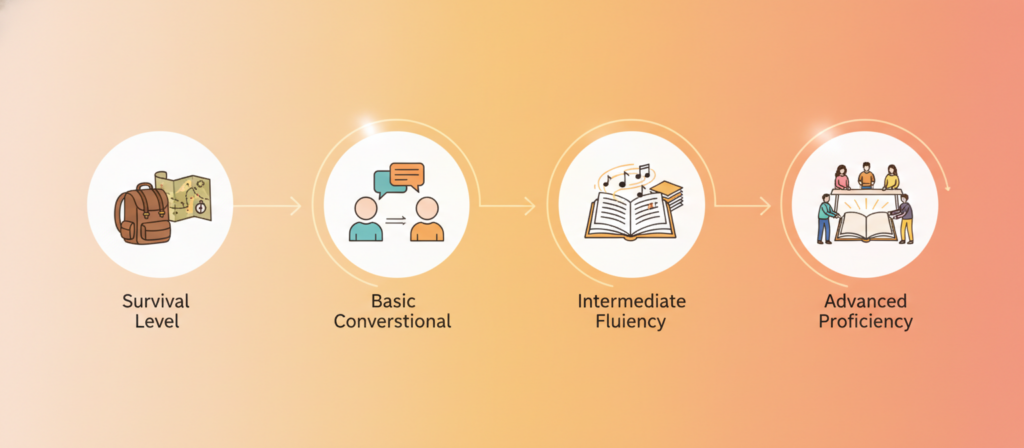
Breaking the path to Spanish fluency into clear stages can make the process feel less overwhelming. Instead of focusing only on a distant goal, you can track your progress through practical milestones.
The timeline below outlines four broad Spanish learning stages, using CEFR Spanish levels as a general reference. These timeframes are illustrative rather than guaranteed; your progress will depend on the intensity and quality of your study.
| Stage | Illustrative Timeframe | Approximate CEFR Level | Key Skills |
|---|---|---|---|
| Survival Spanish | 0–3 months | A1 | Greetings, ordering food, simple questions |
| Conversational Foundations | 3–8 months | A2–B1 | Daily routines, basic past and future forms, familiar conversations |
| Intermediate Fluency | 8–18 months | B1–B2 | Expressing opinions, reading general texts, handling unplanned conversations |
| Advanced Proficiency | 18+ months | C1–C2 | Complex discussion, humour, nuanced comprehension and professional writing |
Step 1: Build Survival Spanish in 0–3 Months
During your first few months, focus on learning enough Spanish to manage common everyday situations. This broadly corresponds to the A1 CEFR level. You might learn greetings, introductions and phrases for ordering food or asking for directions.
You will begin building a core vocabulary and learning common present-tense verbs, numbers and useful sentence patterns. The aim is not to speak perfectly but to communicate basic needs.
With regular daily study and speaking practice, many learners can develop useful survival skills within a few months. Your exact progress will depend on how much time you invest and whether you actively use what you learn.
Step 2: Build Conversational Skills in 3–8 Months
As you progress, you can move from memorised phrases towards more flexible conversations. At the A2 and early B1 CEFR levels, learners typically start discussing familiar topics and describing past or future events in simple terms.
Your active vocabulary will gradually expand, and you will become better able to talk about routines, experiences and straightforward opinions. You will still make mistakes, but successful communication matters more than perfect grammar at this stage.
Speaking practice is essential. Conversation partners and regular sessions with a qualified teacher can provide opportunities to use Spanish while receiving corrections and personalised guidance. At Your Native Teacher, learners can take live online Spanish lessons with qualified teachers and work towards goals such as conversation, travel or professional communication.
After several months of consistent study, some learners can sustain a short conversation on familiar topics. Others may need more time, particularly if they have limited opportunities to speak.
Step 3: Work Towards Intermediate Fluency
Reaching intermediate Spanish fluency commonly takes sustained study over many months or longer. At the B1 to B2 CEFR levels, you can increasingly function independently in familiar situations.
You may be able to discuss a wider range of topics, understand the main ideas in general media and navigate unplanned conversations. Your vocabulary will continue to grow as you read, listen and speak more frequently.
Grammar usually becomes more automatic, although structures such as the subjunctive and less common verb forms may still be challenging. You may also find that listening remains difficult when native speakers talk quickly or use regional expressions.
Keep listening to podcasts, reading suitable books and having regular conversations. Feedback from a teacher can help you identify recurring errors that may be difficult to notice on your own.
Step 4: Develop Advanced Proficiency
Reaching advanced Spanish proficiency generally requires long-term, sustained exposure. C1 and C2 are distinct CEFR levels, and C2 represents an especially high degree of precision, flexibility and comprehension.
At an advanced level, you can use Spanish effectively in many academic, social and professional situations. You may understand humour, idiomatic language and cultural references, although unfamiliar accents or highly specialised subjects can still present challenges.
You will have greater control over complex grammar, idioms and register. Even advanced learners continue to expand their vocabulary and refine their pronunciation over time.
Regular contact with Spanish remains important. This can come through travel, work, study, media or frequent conversations with proficient speakers.
3. Conclusion
There is no single answer to how long it takes to learn Spanish. Your timeline depends on your goals, the time you dedicate each week, the quality of your practice and how often you use the language.
What matters most is steady progress. Moving through the Spanish proficiency levels, from basic phrases to advanced communication, requires consistent effort, useful feedback and regular exposure. No single app, book or course is enough on its own.
Practise regularly, begin speaking early and make Spanish part of your routine. Small, consistent efforts can produce meaningful results over time.
Every proficient speaker once struggled with basic verb conjugations and unfamiliar pronunciation. Start with a manageable lesson or conversation, set a realistic goal and build from there.