


Ever wondered how employers, universities, and language schools measure your German proficiency? One widely used reference is the Common European Framework of Reference for Languages, or CEFR. It provides a clear way to describe your abilities and track your progress. Knowing your level can help you choose suitable learning materials and set realistic goals, whether you’re just starting or improving your German for work or study.
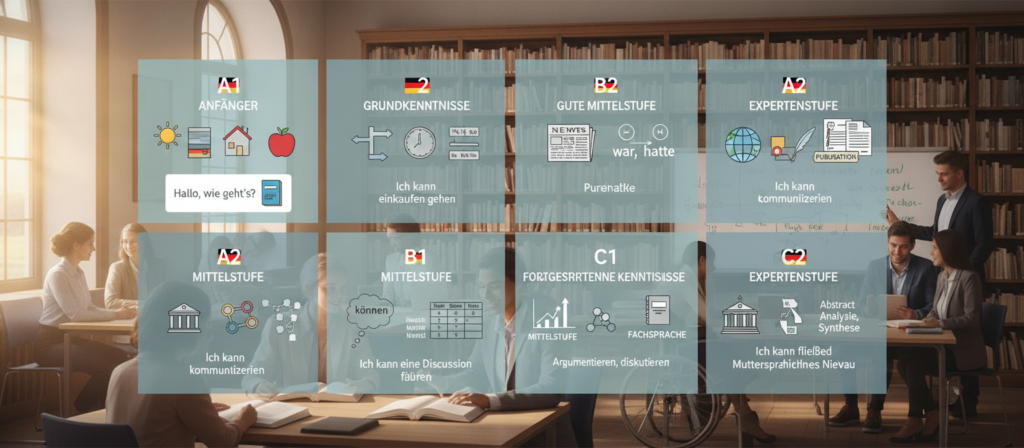
The Common European Framework of Reference for Languages, or CEFR, is widely used to describe language skills across Europe and beyond. It divides proficiency into six levels, from A1 for beginners to C2 for highly proficient users.
Schools, universities, employers and examination providers such as the Goethe-Institut use this framework. Its shared benchmarks make it easier to compare language abilities across courses, qualifications and countries.
In this guide, you’ll learn what each level involves, from using your first German words to communicating precisely in complex academic or professional situations. Each milestone brings new skills, confidence and opportunities on your journey towards fluency.
Key Takeaways
- The CEFR framework describes language proficiency across six levels, from A1 to C2.
- Universities, employers and certification bodies such as the Goethe-Institut commonly use these benchmarks.
- Each level builds specific skills, from basic communication to highly proficient language use.
- The framework is widely used across Europe, including the United Kingdom, and is also recognised internationally.
- Understanding your current level helps you set realistic learning goals.
- This guide explains every level, from your first words to advanced proficiency.
How to Progress Through Each German CEFR Level Step by Step
Going from a beginner to a confident German speaker is a gradual journey made up of clear stages. Learning German step by step helps you build new skills on a strong foundation. With consistent practice, communication can become increasingly natural.
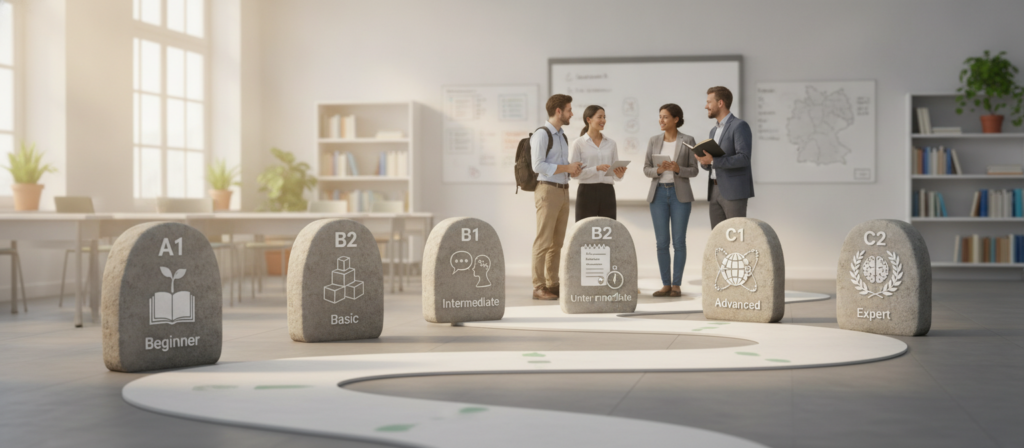
The Common European Framework of Reference (CEFR) divides this journey into six German language proficiency levels. Each level has its own communication goals and typical grammar and vocabulary milestones. The roadmap below can help you track your progress and understand what to focus on next.
Step 1: Build Your Foundation at A1 (Beginner)
Your journey starts with basic communication. At the German A1 level, you’ll learn common greetings, simple present-tense verbs and how to introduce yourself.
You’ll also practise numbers, everyday vocabulary related to topics such as family and food, and short phrases for shopping or ordering a meal. The time required to reach A1 varies considerably according to your previous language experience, lesson frequency and independent practice.
Think of A1 as your basic communication toolkit. You won’t hold deep conversations yet, but you can begin handling simple, familiar interactions.
Step 2: Expand Your Basics at A2 (Elementary)
Once you’re comfortable with the basics, the German A2 level takes you further into everyday communication. You’ll begin using common past-tense forms to talk about what you did yesterday or last week.
Connectors such as “und,” “aber” and “weil” help you link ideas into fuller sentences. You’ll also describe daily routines, share simple past experiences and express immediate needs in short exchanges with shopkeepers, colleagues or new acquaintances.
By this stage, you should have a broader working vocabulary and greater control of common sentence patterns. Exact vocabulary totals are difficult to measure because learners differ in how many words they can recognise and actively use.
Step 3: Reach Independence at B1 (Intermediate)
The German B1 level marks an important turning point. You move beyond relying mainly on memorised phrases and become more independent in familiar situations.
You’ll be better equipped to handle common travel situations, book accommodation and ask for directions. You can express personal opinions on familiar topics such as work, school or hobbies, and understand the main points of clear standard speech and writing.
Reaching B1 generally requires sustained study and practice over time. It is often viewed as a threshold for independent communication, although the language level required for a particular workplace, course or official process will vary.
Step 4: Develop Fluency at B2 (Upper Intermediate)
At the German B2 level, greater fluency and spontaneity become key goals. You should be able to interact with proficient German speakers with enough ease that regular conversation is possible without excessive effort from either person.
You’ll understand more complex texts, including discussions related to your field of interest. You can also produce clear, detailed writing and explain your viewpoint on topical issues with supporting arguments.
Many employers and educational institutions regard B2 as evidence of solid independent proficiency. However, acceptance depends on the organisation, role, course and type of certificate, so you should always check the relevant requirements directly.
Step 5: Master Nuance at C1 (Advanced)
The German C1 level is where nuance becomes increasingly important. You’ll understand implicit meaning, tone and many forms of humour, although unfamiliar cultural references may still present challenges.
You can use German flexibly and effectively for social, academic and professional purposes. Your writing becomes well structured, detailed and suitable for complex tasks such as reports, essays and formal presentations.
Reaching this stage normally demands extensive, focused study and regular exposure to German. C1 is a common admission benchmark for some German-taught university programmes, but requirements vary by institution and course.
Step 6: Attain Proficiency at C2
The final CEFR level, the German C2 level, represents a very high degree of proficiency. You can understand virtually everything you hear or read, including language containing complex ideas, subtle distinctions or specialised vocabulary.
You can summarise information from multiple spoken and written sources, reconstructing arguments coherently. Your spontaneous speech is precise and adaptable, even in demanding academic or professional settings.
C2 requires extensive language knowledge and the ability to communicate with a high degree of precision. It may be useful for interpreters, academics and professionals with especially demanding language needs. However, C2 does not mean that a learner communicates exactly like a native speaker in every context.
| Milestone | Beginner (A1–A2) | Intermediate (B1–B2) | Advanced (C1–C2) |
|---|---|---|---|
| Vocabulary Development | Common words and phrases for familiar needs | Broader vocabulary for opinions, work and study | Extensive vocabulary, including nuanced and specialised language |
| Study Commitment | Regular foundational study and practice | Sustained study with frequent practical use | Extensive study and exposure across complex contexts |
| Core Focus | Survival phrases and basic grammar | Independence, fluency and expressing opinions | Nuance, flexibility and precision |
| Typical Use Case | Travel and simple daily interactions | Work, study and social conversation | Academic and demanding professional communication |
Conclusion
Every stage of the CEFR framework builds on the last, turning what can feel like an overwhelming task into a clear sequence of achievable goals. Your German learning journey doesn’t need to feel like guesswork. From your first greetings at A1 to confident, nuanced expression at C2, each level represents meaningful progress.
Language schools, universities, employers and exam providers use the framework because it provides a shared way to describe ability, choose suitable study materials and set appropriate goals. Exact entry or employment requirements can still differ, so always confirm which level and certificate a particular organisation accepts.
Knowing where you stand now is the first step towards German fluency. Once you understand what separates an A2 learner from a B1 learner, or a B2 learner from someone approaching C1, you can focus your energy on the skills that matter most instead of studying without direction.
Whether you’re preparing to study in Germany, advance your career, connect with family or simply enjoy speaking another language well, the CEFR scale gives you a practical roadmap. If you would benefit from structured lessons and personalised feedback, Your Native Teacher offers live online German lessons with qualified teachers who can adapt their guidance to your current level and goals.