



Ever felt stuck at an intermediate level, wondering how to break through to more confident conversations?
Reaching B1 is already a significant accomplishment. You can chat about daily life, read straightforward articles, and get your point across in many familiar situations.
But the next step opens up a whole new range of possibilities. Imagine handling job interviews more confidently, discussing ideas in greater depth, and understanding natural speech without constantly asking people to slow down.
That’s what moving towards B2 English can help you do. It can support your career goals, deepen your friendships, and give you greater confidence when expressing your ideas.
This guide explains the main differences between B1 and B2, so you know what to expect. You’ll get a clear, practical roadmap covering vocabulary, grammar, listening, speaking, reading, and writing skills.
With steady practice, you can notice meaningful progress over time. Your goal may be closer than you think.
Key Takeaways
- Moving up a language level can lead to smoother conversations and stronger communication skills at work.
- Understanding the gap between skill levels helps you set realistic, achievable goals.
- A focused plan covering all core skills can make your practice more effective.
- Building a richer vocabulary helps you express nuanced opinions with confidence.
- Regular listening and speaking practice strengthens real-world communication.
- Consistent effort over time can transform your overall fluency.
- Tracking small wins keeps you motivated throughout your learning journey.
1. What It Really Takes to Go From B1 to B2 English
Understanding the difference between an intermediate and upper-intermediate speaker is important. Knowing your place within the CEFR English levels makes the journey clearer.
Many learners feel stuck because they do not notice their gradual progress. However, moving from intermediate to upper-intermediate English becomes more manageable when you identify the specific skills you need to develop.
You’re not chasing something vague. You’re working to close an identifiable gap across several language skills, and that goal is achievable with focused practice.
1.1 The Key Differences Between B1 and B2 Level English
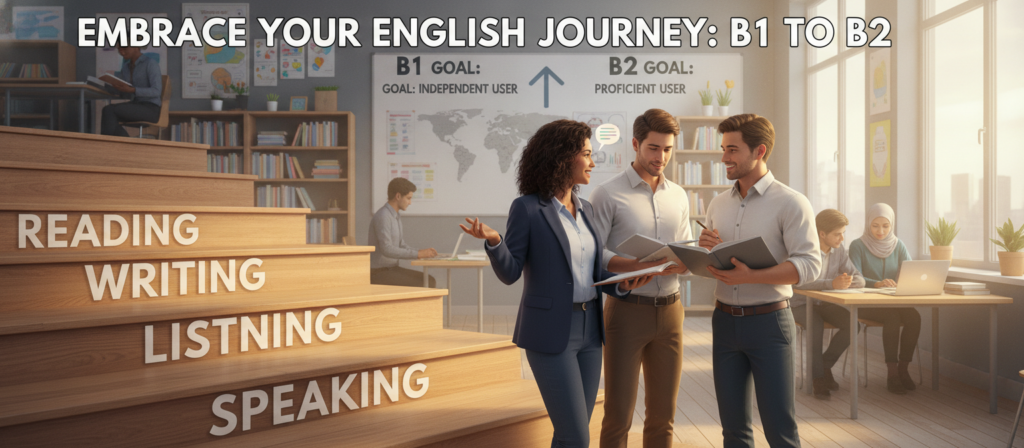
At B1, you can handle many everyday conversations and describe experiences, plans, and familiar topics. B2 takes these abilities further. You can discuss a broader range of subjects, explain viewpoints, and express ideas with greater detail and nuance.
Grammar also helps demonstrate the difference. A B1 speaker might say, “I went to the store yesterday.” A learner working at B2 may use a more complex structure: “By the time I arrived, the store had already closed.” However, CEFR levels reflect overall communication ability rather than the use of one particular grammar structure.
| Skill Area | B1 Level | B2 Level |
|---|---|---|
| Speaking | Communicates about familiar topics and manages many routine situations | Discusses a wider range of topics and explains or supports opinions clearly |
| Grammar | Uses common structures with reasonable control, although errors remain | Uses a wider range of structures, including complex clauses, with greater control |
| Listening | Understands the main points of clear speech on familiar subjects | Follows extended speech and many natural conversations when the topic is reasonably familiar |
| Writing | Writes connected texts about familiar topics and personal experiences | Produces clear, detailed texts, including essays and reports on suitable topics |
1.2 How Long It Realistically Takes to Reach B2
How long does it take to reach B2 English? There is no single reliable answer for every learner. Some estimates suggest that moving from B1 to B2 can require a few hundred hours of guided study and independent practice, but the actual timeline varies considerably.
Your progress depends on your starting point, practice frequency, learning methods, feedback, and regular exposure to English through conversation, reading, media, work, or travel.
Small, consistent efforts add up. Stay patient, review your progress regularly, and adjust your study plan when a particular skill needs more attention.
2. Step-by-Step Strategies to Move From B1 to B2 English
Are you ready to move from B1 to B2 English? These five steps can help you work towards your goal. Each step focuses on a key area: vocabulary, grammar, listening, speaking, and reading and writing. You can follow them in order or return to any step when needed. Remember, progress comes from consistent, purposeful effort rather than perfection.
2.1 Step 1: Expand Your Vocabulary With Purpose
Building a strong vocabulary involves more than memorising individual words. At B2, you need to understand how words are commonly combined and used in context.
Start by learning phrasal verbs and collocations, not just single words. For example, learn “make a decision” as a complete phrase rather than studying only the word “decision.”
Organise new vocabulary into themes such as business, travel, or health. This can make it easier to retrieve and use the language in real conversations.
Use spaced-repetition tools to review words at suitable intervals. Read level-appropriate content regularly as well, noting useful phrases rather than trying to record every unfamiliar word.
2.2 Step 2: Master Intermediate-to-Advanced Grammar
B2 grammar involves using a broader range of structures accurately enough to communicate detailed ideas.
Focus on conditionals, the passive voice, reported speech, relative clauses, and ways to connect ideas. These areas can also be useful for B2 English exam preparation, including Cambridge B2 First. IELTS is not tied to one CEFR level, but many of the same grammar skills are relevant to its tasks.
Do not rely on memorisation alone. Practise by rewriting sentences in the passive voice, changing direct speech into reported speech, and using target structures in short texts about your own experiences.
Grammar and writing tools can help you identify possible mistakes, but their suggestions are not always correct. Combine them with reliable reference materials and personalised feedback from a qualified teacher whenever possible.
2.3 Step 3: Train Your Ear With Authentic Listening Practice
Listening to authentic English helps you become familiar with natural rhythm, connected speech, and a variety of accents.
Listen to podcasts, interviews, and TV programmes. Choose topics that interest you and materials that are challenging but still understandable.
Try listening without subtitles or a transcript first, then use them to check what you missed. Listen again and note useful phrases or pronunciation features.
Short, regular listening sessions are often easier to maintain than occasional long sessions. Aim for a routine you can follow consistently.
2.4 Step 4: Build Real Speaking Confidence and Fluency
Speaking confidence develops through regular practice. Mistakes are a normal part of trying more complex language and can show you what to work on next.
Use language-exchange platforms or local conversation groups as supplementary ways to practise informal conversation. For structured progress, personalised correction, and targeted speaking tasks, lessons with a qualified teacher can help. At Your Native Teacher, learners can work online with qualified teachers and receive guidance based on their level and goals.
Shadowing, which involves repeating a speaker’s words while copying their rhythm and intonation, can support pronunciation practice. Try it with short audio clips and compare your version with the original.
Record yourself speaking every few weeks and compare the recordings. Listen for changes in clarity, range, accuracy, and hesitation rather than expecting every aspect of your English speaking fluency to improve at the same rate.
2.5 Step 5: Strengthen Your Reading and Writing Skills
Reading and writing reinforce other areas of language learning. They expose you to grammar and vocabulary in context and give you time to organise more complex ideas.
Read different types of texts, such as news reports, stories, reviews, and opinion pieces. Each type can develop your English reading and writing skills in a different way.
Write regularly as well. Journal entries, short essays, reviews, emails, and carefully written social media posts can all provide useful practice.
These habits can also support B2 English exam preparation, especially when you practise the task types and time limits used in your chosen exam. Feedback is particularly valuable because it helps you identify recurring problems that self-study may not reveal.
| Skill | Recommended Practice | Helpful Tools | Weekly Goal |
|---|---|---|---|
| Vocabulary | Learn phrasal verbs and collocations in context | Spaced-repetition tools, graded readers | 5–7 sessions of 15 minutes each |
| Grammar | Practise conditionals, the passive voice, and reported speech | Writing tools, reference materials, teacher feedback | 3–4 focused sessions |
| Listening | Listen first without subtitles or a transcript, then review | Interviews, TV programmes, podcasts | 15–20 minutes on most days |
| Speaking | Guided conversation, shadowing, and self-recording | Online lessons, language exchanges, local conversation groups | 3–5 sessions |
| Reading & Writing | Read varied texts and write essays or journal entries | News sites, graded materials, journaling tools | 4–6 sessions |
3. Conclusion
Reaching B2 English is not about taking one big step. It is the result of many smaller improvements. Learning useful phrases, practising grammar, understanding podcasts more clearly, and speaking more confidently all contribute to your progress.
Some days may feel slow. You might forget a verb tense or struggle during a conversation, but this is normal. Language learning is not always linear.
Remember your small victories. Perhaps you understood a video without subtitles or had a five-minute conversation without translating every sentence. These moments show that your skills are developing and can keep you motivated when progress is difficult to see.
You do not always need a long study session to improve your English. Twenty or thirty minutes of focused practice can be valuable when it forms part of a consistent routine. Try one strategy from this guide today.
Reaching B2 is an achievable goal for many learners, but the time and support required will vary. Be patient with yourself, seek feedback when you need it, and keep building your confidence through regular use of English.