


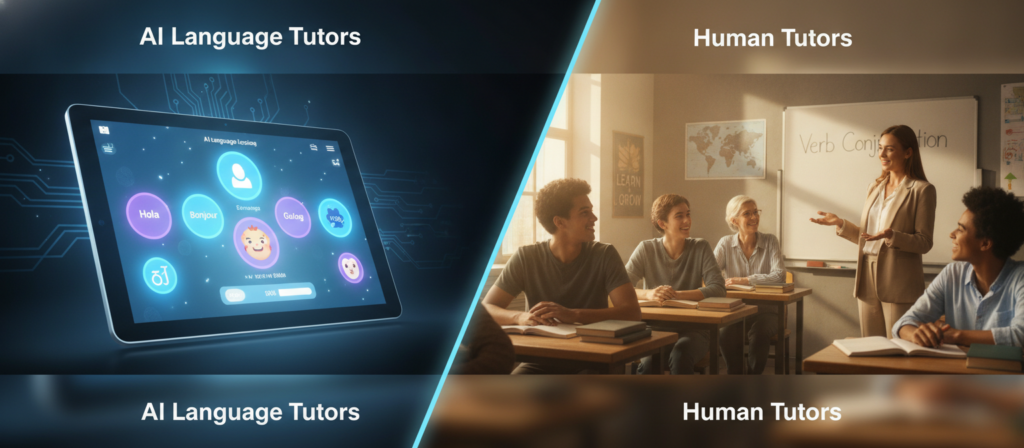
Can a smartphone app really teach you to speak naturally and confidently? This is an important question for anyone learning a new language. Digital tools are changing how learners study and practise.
AI-powered language-learning apps can adapt exercises, provide pronunciation feedback and track your progress in real time.
On the other hand, live online lessons connect you with real teachers who can provide cultural context, personalised feedback and flexible speaking practice. These are areas in which an app may be more limited.
Each approach has its own benefits. Understanding them can save you time, money and frustration.
Both methods can support progress, but they suit different needs, goals and budgets.
This guide explains the basics and compares the cost, effectiveness and flexibility of AI language tutors and human teachers. You’ll get a clearer idea of whether an AI tool, a human teacher or a combination of both is right for you.
Key Takeaways
- AI-powered language-learning apps provide instant feedback and allow you to practise at any time.
- Live teachers offer cultural insights, personalised correction and genuine conversation practice that apps cannot fully replicate.
- Cost, learning style and goals all influence which method is best for you.
- This article compares features, pricing models and potential benefits to help you choose with confidence.
- A simple recommendation framework will guide you towards the right fit for your learning journey.
- Using AI tools alongside teacher-led lessons may offer a balanced approach to language learning.
1. AI Language Tutor vs Human Tutor: Understanding the Basics
Every language learner faces a choice between software-based practice and lessons with a real teacher. Both can support language development, but they work in very different ways. First, let’s explore what each option offers.

1.1 What Is an AI Language Tutor?
An AI language tutor is software that uses technologies such as machine learning, natural language processing and speech recognition. Language-learning apps with AI conversation, grammar or pronunciation features fall into this category.
These tools can provide quick feedback on pronunciation and grammar. Some also adjust the difficulty of exercises based on your performance. This supports personalised language learning without requiring a teacher to be present.
With AI, you can practise at almost any time. The system may track your progress and use repetition to help you retain vocabulary and language patterns.
1.2 What Is a Human Language Tutor?
A human language tutor is a teacher or instructor who teaches through explanation, conversation, correction and guided practice. Qualified online teachers, private tutors and language coaches are examples.
Unlike AI, a human teacher can respond to your uncertainty, motivation and individual communication style. They can change their approach when an explanation is not working and build lessons around your specific needs.
Human teachers can also explain cultural nuances, tone and context in greater depth. Although lessons require scheduling, many learners value the structure, accountability and personal interaction they provide.
| Feature | AI Language Tutor | Human Language Tutor |
|---|---|---|
| Availability | Usually available on demand | Available through scheduled sessions |
| Feedback Style | Instant and algorithm-based | Real-time and context-aware |
| Cultural Insight | Limited to available training data and programmed content | Can provide detailed cultural and social context |
| Typical Language Tutor Pricing | Often offered through a monthly subscription or limited free plan | Usually charged per lesson or as part of a lesson package |
2. Comparing Costs, Effectiveness, and Flexibility
Before you decide, consider the cost, learning experience and flexibility of each option. This comparison highlights the main differences between AI tutors and human instructors so that you can choose what fits your goals and budget.
2.1 Cost Comparison: Pricing Models Explained
AI language tutors are commonly offered through monthly or annual subscriptions, although some tools include free features. A subscription may include frequent practice sessions, making the cost predictable for learners who use the tool regularly.
Human teachers usually charge per lesson or offer lesson packages. Rates vary according to lesson length, teacher qualifications, subject specialisation and the level of personalisation provided. Teacher-led learning generally costs more than an app, but the fee includes live instruction, tailored feedback and accountability.
2.2 Learning Effectiveness and Retention
AI can be useful for repetitive tasks. It can check pronunciation, generate practice questions and help you review new words regularly.
Human teachers are particularly valuable for developing natural conversation skills. They can notice subtle mistakes, ask follow-up questions and explain cultural or contextual details that automated systems may miss.
Many learners benefit from using both: AI for convenient independent practice and a human teacher for structured guidance and meaningful communication.
2.3 Flexibility, Availability, and Personalization
AI tutors are usually available whenever you want to practise. You can complete a short activity at almost any time without booking a session.
Human teachers require scheduling, but they offer one-on-one language lessons tailored to your needs, whether you are learning for work, an exam, travel or everyday conversation.
This kind of personalised learning can be especially helpful when you have a specific goal or need detailed feedback. At Your Native Teacher, learners can work online with qualified teachers and receive guidance based on their level, goals and areas for improvement.
| Factor | AI Language Tutor | Human Tutor |
|---|---|---|
| Cost Model | Typically a free plan or recurring subscription | Typically priced per lesson or lesson package |
| Feedback Quality | Instant, pattern-based corrections | Nuanced, context-aware corrections |
| Availability | Usually available on demand | Requires booking at an agreed time |
| Personalization | Algorithm-driven suggestions | Custom lesson planning based on the learner’s goals |
2.4 Pros and Cons Overview
Every method has advantages and limitations. Here is a clear comparison to help you decide.
2.4.1 Advantages of AI Language Tutors
AI tutors offer convenient, low-pressure practice whenever you want it.
- Predictable cost: many tools use a recurring subscription model or provide limited free access.
- Constant availability: you can practise at almost any time.
- Low-pressure repetition: you can repeat drills as often as you need.
2.4.2 Advantages of Human Tutors
Human instructors bring personal interaction and cultural insight to each lesson.
- Real-time correction: a teacher can identify subtle errors and explain how to fix them.
- Cultural context: teachers can explain idioms, tone and social nuances.
- Custom lessons: personalised one-on-one language lessons can be built around your goals.
2.4.3 Limitations of AI Language Tutors
AI tutors can support regular practice, but they also have limitations.
- Limited explanations: responses to complex grammar questions may be unclear or inaccurate.
- Limited cultural judgement: AI may misinterpret tone, humour or social context.
- Generic responses: automated feedback may not identify the exact cause of a mistake.
2.4.4 Limitations of Human Tutors
Human tutors also have practical limitations that AI tools do not face.
- Higher cost: live personalised instruction generally costs more than app-based practice.
- Scheduling requirements: sessions depend on both parties’ availability.
- Variable quality: qualifications, experience and teaching skill can differ between tutors, so it is important to choose carefully.
3. Conclusion: Which Tutor Fits Your Language Goals?
Choosing the right tutor depends on your goals. If you need to review basic vocabulary before a trip, an AI tutor may provide quick and convenient practice. For exam preparation, professional communication or advanced fluency, a qualified human teacher can offer structured support and more precise feedback.
Consider what you need rather than relying on marketing claims. Your goals, learning preferences and current level should guide your choice.
Many learners combine AI tools with human instruction. AI can support short daily practice, while teacher-led lessons develop conversation skills, accuracy and confidence. This combination can provide a balanced learning routine.
Before choosing, ask yourself a few questions. What is your budget? How much time do you have? What level do you want to reach? Do you need exam preparation, business-language training or general conversation practice? Your answers will help you decide whether an app, live lessons or a combination of both is the best fit.