


Have you ever found yourself wondering whether to say “I have visited London” or “I visited London last year”? Many English learners face this dilemma.
Choosing the right tense is important because it tells your listener whether an action belongs to a finished past time or is connected to the present.
Fortunately, there is a practical way to choose the correct tense. You can use a straightforward method to make tense selection easier in both speaking and writing.
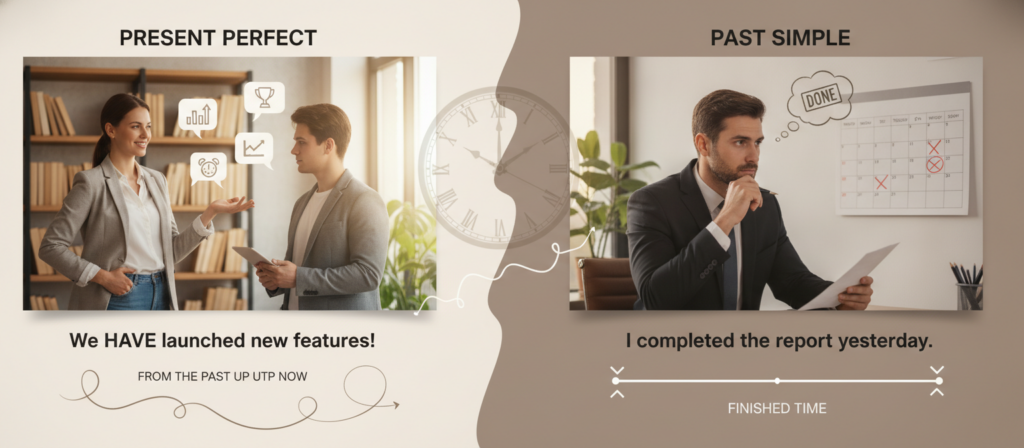
This guide explains the tenses clearly, highlights their differences, and offers a step-by-step process. You’ll see how the present perfect tense connects past actions or situations to the present. In contrast, the past simple tense usually describes an action or situation in a finished past time.
By the end of this guide, you’ll be better prepared to use both tenses in everyday situations. Whether you’re talking with friends, writing emails, or taking an English exam, these rules and examples will help.
Key Takeaways
- Two common English tenses often cause confusion for learners: one connects earlier actions or situations to the present, while the other places them in a finished past time.
- Choosing the wrong tense can change the meaning your listener understands.
- Time markers such as “yesterday” or “already” often provide useful clues when choosing the right form.
- A clear, step-by-step method makes tense selection much easier to understand.
- Everyday examples, such as travel stories, help highlight the practical difference.
- Regular practice with real sentences builds confidence in conversation and writing.
1. Present Perfect vs Past Simple: Understanding the Core Differences
English learners often get confused about the difference between the past simple and present perfect. Both refer to actions or situations before now, but they are used differently.
Knowing the present perfect vs past simple rules can make your English clearer. We’ll look at each tense separately and then compare them.

1.1 What Is the Past Simple Tense?
The past simple tense is generally used for completed actions or situations in a finished past time. Regular verbs usually take “-ed,” as in “walked” or “played.”
Irregular verbs have different past forms, such as “went” or “saw.” This tense is often used when the speaker mentions a finished time or when the past context is already clear.
For example, “You called your friend yesterday” tells us when the action happened. This is a clear past simple vs present perfect example in everyday English.
1.2 What Is the Present Perfect Tense?
The present perfect tense connects a past action or situation to the present. It is formed with “have” or “has” plus a past participle.
For instance, “You have called your friend twice this week” describes past actions within a time period that is not yet finished. It remains relevant because the week is still continuing.
This tense is commonly used for life experiences, recent events with a present result, changes over time, and situations that began in the past and continue now. It does not normally appear with a specific, finished past time expression such as “yesterday” or “in 2020.”
1.3 Key Differences in Meaning and Use
Understanding present perfect vs simple past differences depends mainly on three things: the time period, whether the action or situation is complete, and its connection to the present.
The past simple places an action or situation in a finished past context. The present perfect connects past events or situations to now, often without naming a specific finished time.
| Aspect | Past Simple | Present Perfect |
|---|---|---|
| Formation | Past form of the verb: usually verb + “-ed” or an irregular form | Have/Has + past participle |
| Time Reference | Finished past time | Unspecified past time or a time period continuing up to now |
| Example | You called your friend yesterday. | You have called your friend twice this week. |
| Connection to Present | The event is presented as part of a finished past context | The event or situation has a connection to the present |
2. How to Choose the Right Tense: A Step-by-Step Guide
Choosing between the present perfect and past simple becomes easier when you follow a simple three-step process. This guide will show you how to select the appropriate tense for your sentence. We’ll also cover common mistakes learners make.
2.1 Step 1: Determine If the Time Period Is Finished or Unfinished
First, ask whether the time period you’re talking about is over. This question can resolve many cases of tense confusion.
Finished time period grammar usually calls for the past simple. Use it for periods that are over, such as “last summer,” “yesterday,” or “in 2019.”
Unfinished time period grammar is different. The present perfect is often used for periods that continue up to now, such as “today,” “this year,” or “so far.” However, the intended meaning and context still matter. For example, “I had lunch today” uses the past simple because the lunch is treated as a completed event, even though today has not ended.
2.2 Step 2: Watch for Signal Words and Time Expressions
After checking the time period, look for clues in the sentence. Certain signal words for tenses can help you choose the right tense.
Time expressions in English often point towards the past simple or present perfect. They are useful clues, but they should be considered together with the sentence’s meaning and context.
| Tense | Common Signal Words | Example Sentence |
|---|---|---|
| Past Simple | yesterday, last night, in 2015, ago, when I was young | She visited Paris last spring. |
| Present Perfect | already, yet, since, for, just, never, ever | She has already visited Paris. |
| Present Perfect | so far, up to now, recently | He has recently changed jobs. |
Learning these common patterns can help you choose the right tense more confidently.
2.3 Step 3: Practice With Real-Life Examples
Reading about tense rules is useful, but using them in real situations is how you develop confidence. Try applying both tenses when talking or writing about everyday experiences.
In a job interview, you might say, “I have worked in marketing for five years,” if your career in marketing is still ongoing. If you’re talking about a specific completed project, use the past simple: “I managed a campaign in 2021.”
Travel stories work in a similar way. “I have visited ten countries” describes your life experience without specifying when each trip happened. In contrast, “I visited Spain last June” refers to a finished trip at a stated time. Using examples like these as present perfect vs past simple exercises will help you understand the difference.
2.4 Common Mistakes and How to Correct Them
English learners often make predictable errors with these tenses. Recognising these common mistakes in English tenses can help you avoid them.
- Mistake: “I have seen him yesterday.” Correction: “I saw him yesterday,” because “yesterday” identifies a finished past time.
- Mistake: “I lived here for ten years” when you still live there. Correction: “I have lived here for ten years,” because the situation continues now.
- Mistake: “I worked here since 2018” when you still work there. Correction: “I have worked here since 2018.”
Regularly reviewing these patterns will improve your confidence and help you use both tenses more accurately.
3. Conclusion
Choosing between the present perfect and past simple becomes easier when you consider whether the sentence refers to a finished past context or connects the past to the present.
Look for clues about finished and unfinished time periods, and notice expressions such as “yesterday,” “since,” and “already.” Remember that these words are clues rather than automatic rules, so you should also consider the intended meaning.
Improving your grammar takes regular practice. Try writing about your day using both tenses, then read your sentences aloud and explain why you selected each form. You can also ask a friend or teacher to identify any errors you may have missed.
Grammar skills grow through practice, not just memorisation. The more you use these patterns in conversation and writing, the more natural they will become. If you need personalised feedback, Your Native Teacher offers live online lessons with qualified teachers who can help you practise grammar in situations relevant to your goals.